
Tennis Elbow Treatment
Evidence-based physiotherapy to relieve tennis elbow pain and rebuild tendon strength, in Sarita Vihar, Delhi NCR.
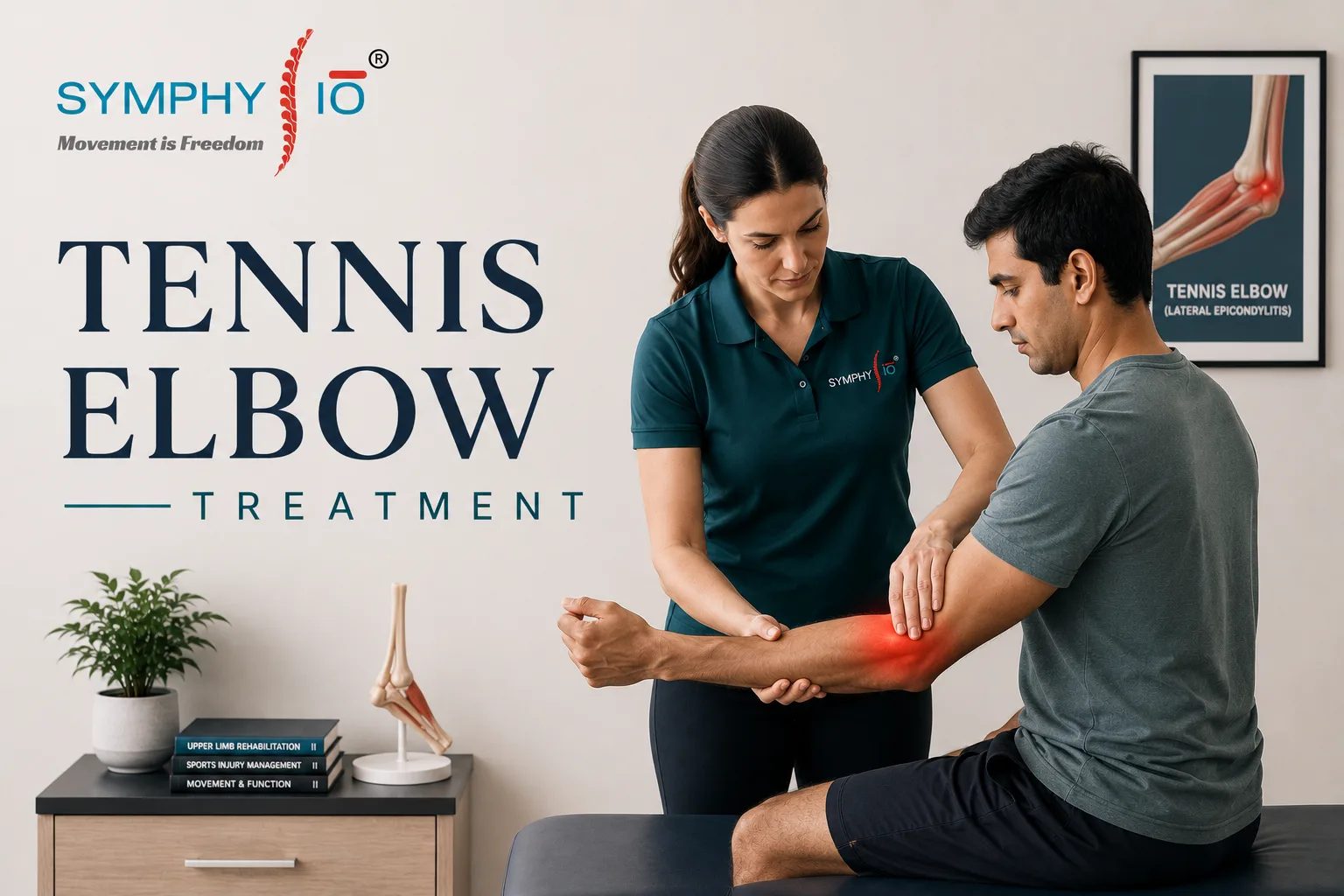
Tennis Elbow
What Is Tennis Elbow?
Tennis elbow, medically known as lateral epicondylitis, is a condition involving pain and tenderness on the outer part of the elbow, caused by overuse-related changes to the tendons that attach the forearm extensor muscles to the elbow. Despite its name, tennis elbow affects far more people from repetitive work and daily activities than from tennis itself — anyone whose activities involve repeated gripping, wrist extension, or forearm rotation can develop it.
Recent understanding of tennis elbow has shifted from viewing it purely as "inflammation" to recognizing it as a tendinopathy — a condition involving structural changes within the tendon from repetitive overload, which is why modern treatment focuses heavily on progressive loading rather than just rest.
Symptoms & Causes
Common symptoms include:
- Pain and tenderness on the outer (lateral) side of the elbow
- Pain that worsens with gripping, lifting, or twisting movements
- Weakness in grip strength
- Pain that may radiate down the forearm
- Symptoms that build gradually over time rather than appearing suddenly
- Discomfort with simple tasks like shaking hands, lifting a cup, or turning a doorknob
Common underlying causes:
- Repetitive gripping or wrist extension activities — manual work, computer use, racquet sports, or repetitive lifting
- Sudden increase in activity involving the forearm and wrist
- Poor technique in sport or work-related tasks placing excess strain on the tendon
- Age-related tendon changes, most commonly affecting people between 35-55
- Insufficient recovery time between repetitive activities
How We Assess It
Assessment focuses on confirming tennis elbow as the diagnosis and understanding your specific contributing factors:
- Palpation and provocation testing — identifying the specific tender area at the lateral elbow and reproducing symptoms with resisted wrist extension and grip testing
- Grip strength assessment — measuring current strength deficits compared to your unaffected side
- Activity and movement analysis — understanding what specific tasks, sports, or work activities are driving the repetitive strain
- Screening for other causes — ruling out nerve-related or referred pain from the neck that can sometimes mimic tennis elbow symptoms
This helps confirm the diagnosis and identify the specific activities that need to be addressed as part of your recovery and prevention plan.
Our Treatment Approach
Modern tennis elbow treatment centers on progressive tendon loading rather than rest alone:
- Progressive loading exercises — a structured program of eccentric and isometric strengthening exercises, gradually increasing tendon load in a controlled way to promote genuine tendon healing and adaptation
- Manual therapy — soft tissue release and joint mobilization to address associated stiffness and muscle tension in the forearm and elbow
- Activity modification guidance — practical adjustments to work, sport, or daily tasks to reduce excessive strain while remaining as active as possible
- Grip and forearm strengthening — building overall forearm strength and endurance to support long-term tendon health
- Bracing or taping guidance — where appropriate, to help manage symptoms during the early stages of treatment or return to activity
Complete rest is generally not recommended, since some controlled loading is important for genuine tendon recovery — your therapist will guide you on the right balance.
Benefits of Treatment
- Reduces elbow pain and tenderness
- Restores grip strength and forearm function
- Addresses the underlying tendon loading issue, not just symptoms
- Supports safe return to sport, work, or daily activities
- Reduces recurrence through activity modification and ongoing strength maintenance
- Avoids the prolonged, incomplete recovery that can result from rest alone without proper loading
Who Should Consider This / Contraindications
Physiotherapy is highly effective for most cases of tennis elbow, particularly with the modern progressive loading approach. It's approached with medical evaluation first in cases of:
- Suspected fracture or acute traumatic injury to the elbow
- Signs of nerve involvement (numbness, tingling, significant weakness) that may suggest a different underlying cause
- Symptoms not responding to a reasonable course of appropriate treatment, where further investigation may be warranted
Our therapists will confirm tennis elbow as the correct diagnosis before beginning treatment, since several other conditions can present with similar elbow pain.
Frequently Asked Questions
No, complete rest is generally not recommended — modern treatment focuses on controlled, progressive loading rather than avoiding all activity, since some loading is important for genuine tendon recovery.
This varies, but tendinopathies like tennis elbow often take longer to resolve than muscle strains — commonly several weeks to a few months with consistent treatment, given the nature of tendon healing.
No, despite the name, tennis elbow is more commonly caused by repetitive work tasks, computer use, manual labor, or other activities involving repeated gripping and wrist movement rather than tennis specifically.
A brace can be a helpful supportive tool during certain phases of treatment or return to activity, but it's typically used alongside — not instead of — a proper progressive loading exercise program.
Counterintuitively, controlled, progressive exercise loading is what actually promotes tendon healing and adaptation — the key is dosing the load appropriately, which is exactly what a structured physiotherapy program provides.
It can, particularly if the original contributing activity or technique issue isn't addressed. This is why treatment includes activity modification and ongoing strength maintenance, not just resolving the current episode.
No — tennis elbow (lateral epicondylitis) affects the outer elbow, while golfer's elbow (medial epicondylitis) affects the inner elbow. Both involve similar tendon overload mechanisms but on opposite sides of the joint.
Not usually — tennis elbow is typically diagnosed clinically through history and specific physical tests. Imaging is occasionally used if the diagnosis is unclear or symptoms aren't responding as expected.
In most cases yes, with activity modifications your therapist will guide you through — complete work absence is rarely necessary, though certain specific tasks may need temporary adjustment.
Without appropriate management, symptoms can persist for a prolonged period and may become more resistant to treatment over time, which is why earlier intervention with proper loading tends to produce better outcomes.
Related Treatments
Frozen Shoulder
Physiotherapy for frozen shoulder in Sarita Vihar, Delhi NCR — stage-specific assessment, hands-on mobilization & progressive rehab.
Learn More
Sports Injury Rehab
Sports injury physiotherapy in Sarita Vihar, Delhi NCR — root-cause assessment, hands-on rehab & return-to-sport programs for athletes.
Learn More
Dry Needling
Dry needling for muscle trigger points, chronic pain & tension in Sarita Vihar, Delhi NCR — precise, evidence-informed technique.
Learn MoreTennis Elbow in Sarita Vihar & South Delhi
Symphysio provides tennis elbow to patients across South Delhi. Our clinic in Sarita Vihar is easily accessible from:
Not sure if we cover your area? Contact us.
Get Back to Full Strength, Pain-Free
Book a tennis elbow assessment with Symphysio in Sarita Vihar today.