
Fascial Manipulation
Advanced deep tissue therapy that treats chronic myofascial pain at its true origin, in Sarita Vihar, Delhi NCR.
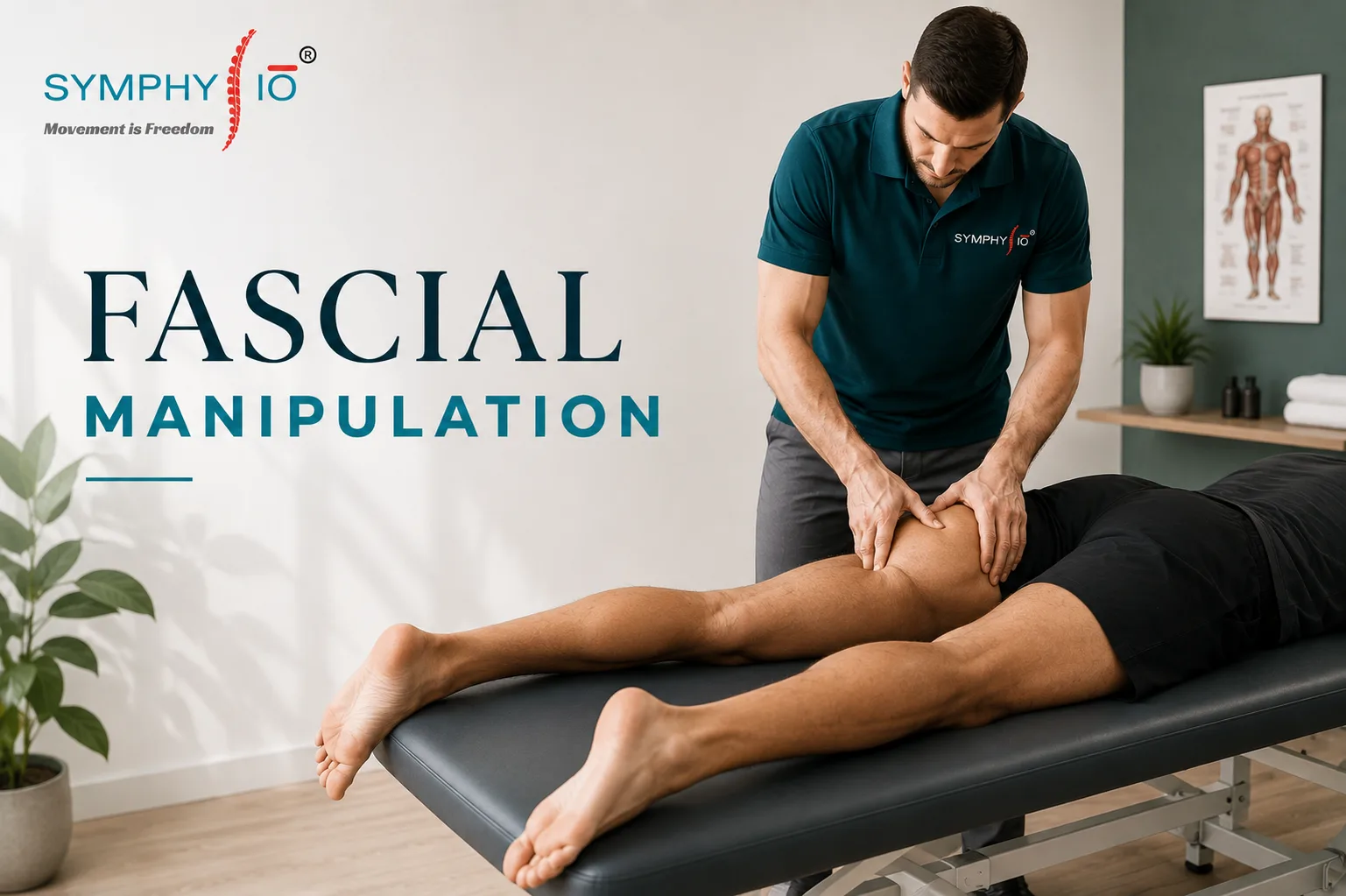
Fascial Manipulation
What Is Fascial Manipulation?
Fascia is the continuous web of connective tissue that wraps every muscle, nerve, blood vessel, and organ in the body. Fascial Manipulation is a manual therapy technique that treats densified, thickened areas within this fascial network — points where the tissue has lost its normal elasticity and glide, often due to overuse, injury, or prolonged poor posture. Because fascia forms an interconnected system across the entire body, a restriction in one area can produce pain in a completely different, seemingly unrelated location.
Developed by Italian physiotherapist Luigi Stecco, Fascial Manipulation uses a structured, segment-based assessment model to map these densified points — called Centers of Coordination — and treat them with deep, friction-based manual pressure. At Symphysio, this technique is particularly valuable for patients whose pain has resisted standard treatment, since it often reveals connections between symptom location and true tissue origin that aren't obvious through conventional assessment.
Symptoms & Causes
Fascial restrictions commonly present as:
- Chronic myofascial pain that shifts location or doesn't map cleanly to a single muscle
- Reduced flexibility despite regular stretching
- Pain that recurs after temporary relief from massage or standard physiotherapy
- Stiffness following repetitive strain, old injuries, or long periods of poor posture
- Referred pain patterns — for example, hip tightness contributing to knee pain, or a shoulder restriction linked to mid-back tension
- Pain that persists despite a lack of clear structural findings on imaging
Fascial densification commonly develops due to:
- Overuse
- Injury
- Prolonged poor posture
How We Assess It
Assessment follows the Stecco method — a systematic evaluation of fascial segments across the body to identify densified Centers of Coordination and Centers of Fusion:
- Movement testing — evaluating movement patterns across body segments to identify where restrictions are actually limiting function
- Precise palpation — locating specific densified points within the fascial network, guided by the segment-based assessment model
- Pain pattern tracing — connecting your reported symptom location back to its true fascial origin, which is often at a distance from where you actually feel pain
This is one of the key strengths of Fascial Manipulation — it's specifically designed to find the source, not just treat where it hurts.
Our Treatment Approach
Treatment uses deep, friction-based manual pressure applied directly over the identified fascial restriction points, generating localized heat and mechanical stimulation that helps restore the tissue's natural glide and elasticity. Sessions can produce temporary soreness — similar to intense deep tissue work — followed by a marked improvement in mobility and pain, often within 24-48 hours. Fascial Manipulation is frequently combined with:
- Movement retraining — reinforcing the improved mobility gained during treatment with appropriate exercise
- Complementary manual therapy — such as Visceral Manipulation or Chiropractic Adjustment, where restrictions extend beyond the fascial system alone
- Postural correction — addressing the patterns that originally contributed to fascial densification
Benefits of Treatment
- Resolves chronic myofascial pain at its true origin, not just the pain site
- Restores flexibility and normal movement patterns
- Complements sports injury rehabilitation and post-surgical recovery
- Reduces recurrence of pain compared to symptomatic-only treatment
- Improves outcomes for long-standing pain that hasn't responded to other therapies
- Provides a structured, evidence-based explanation for pain patterns that otherwise seem unclear
Who Should Consider This / Contraindications
Fascial Manipulation is ideal for patients with chronic, recurring musculoskeletal pain, athletes managing overuse injuries, and anyone whose pain has resisted standard treatment approaches. It's particularly valuable when pain patterns seem to "move around" or don't map clearly to a single structure. It is generally avoided, or approached with caution, in cases of:
- Active skin infections at the treatment site
- Recent fractures in the treatment area
- Deep vein thrombosis
- Suspected malignancy in the treatment area
- Patients on blood thinners, where technique is modified accordingly
Our therapists screen for these factors before beginning treatment.

Frequently Asked Questions
Fascial Manipulation follows a structured, segment-based assessment model to identify specific densified points (Centers of Coordination) that may be at a distance from your pain, rather than general deep pressure applied broadly. It's a more targeted, diagnostic approach.
Yes — this is one of the classic presentations Fascial Manipulation is designed to address, since fascial restrictions often refer pain to sites away from the actual problem area, which is exactly what this assessment model is built to trace.
Some temporary soreness is common for 24-48 hours after treatment, similar to a deep tissue massage, followed by noticeable improvement in mobility and pain.
This varies by case, but many patients notice meaningful changes within 3-5 sessions. Chronic, long-standing restrictions may need a longer course of treatment.
The deep, friction-based pressure can feel intense during treatment, similar to firm deep tissue work, but it's generally well-tolerated and the discomfort is brief and localized to the treatment points.
Yes, it's often combined with Visceral Manipulation, Chiropractic Adjustment, or standard exercise-based physiotherapy, depending on what your full assessment reveals.
Very much so — it's frequently used for overuse injuries and recurring tightness patterns in athletes, where standard stretching and massage haven't resolved the underlying restriction.
Standard massage often provides temporary relief by relaxing muscle tension, but if the underlying issue is a densified fascial restriction, the true source isn't being addressed — which is exactly the gap Fascial Manipulation is designed to close.
Yes, it can be a valuable part of post-surgical rehabilitation once the surgical site has sufficiently healed, helping address fascial restrictions that develop around the area.
Through the structured Stecco assessment method — movement testing and precise palpation guided by an anatomical map of fascial segments help trace your specific pain pattern back to its true origin point.
Related Treatments
Visceral Manipulation
SignatureVisceral Manipulation therapy in Sarita Vihar, Delhi NCR — gentle, root-cause treatment for chronic pain linked to organ and fascial mobility.
Learn More
Chiropractic Adjustment
Chiropractic Adjustment in Sarita Vihar, Delhi NCR — physiotherapist-led spinal manipulation for mechanical neck & back pain.
Learn More
Dry Needling
Dry needling for muscle trigger points, chronic pain & tension in Sarita Vihar, Delhi NCR — precise, evidence-informed technique.
Learn MoreFascial Manipulation in Sarita Vihar & South Delhi
Symphysio provides fascial manipulation to patients across South Delhi. Our clinic in Sarita Vihar is easily accessible from:
Not sure if we cover your area? Contact us.
Find the True Source of Your Pain
Book a Fascial Manipulation assessment with Symphysio in Sarita Vihar today.