Cervical Spondylosis and Dizziness: Can Neck Problems Cause Vertigo? Physiotherapy in Sarita Vihar
Cervical spondylosis treatment in Sarita Vihar: understand neck-related dizziness, warning signs, safe exercises and physiotherapy at Symphysio, Delhi.

Written by Dr. Rahul Bhandari, PT, MPT (Sports)
Published October 19, 202614 min read
In this article
You turn your head to look over your shoulder, and suddenly the room seems to spin. Perhaps you also experience neck stiffness, a headache at the back of your head, or tingling in your hands. These symptoms can be worrying, especially when they interfere with driving, working or everyday activities.
If you are searching for cervical spondylosis treatment, it is important to understand whether your dizziness is related to your neck or another condition. Cervical spondylosis is a common age-related change in the neck, but dizziness should never automatically be blamed on it.
At Symphysio, a physiotherapy and chiropractic clinic in Sarita Vihar, New Delhi, we assess neck movement, posture, muscle function and balance to help identify appropriate treatment options. In this guide, you will learn about cervical spondylosis symptoms, possible causes of dizziness, warning signs that need medical attention, safe home exercises and how physiotherapy may help you move more comfortably.
Key takeaways
- Cervical spondylosis involves age-related changes in the discs and joints of your neck.
- Neck-related dizziness, sometimes called cervicogenic dizziness, is possible, but other causes must be considered first.
- Physiotherapy may help improve neck mobility, strength, posture and balance when clinically appropriate.
- Sudden dizziness with speech difficulties, facial drooping, double vision or weakness requires emergency medical care.
- An individual assessment at Symphysio can help guide your next steps and a suitable rehabilitation plan.
What is cervical spondylosis?
Your cervical spine consists of seven vertebrae in your neck, separated by discs that help absorb everyday loads. Small joints, ligaments and muscles allow you to turn, tilt and support your head.
With ageing, these structures can gradually change. The discs may lose some of their water content and height, joints can become stiffer, and bone spurs may develop. These changes are collectively known as cervical spondylosis.
Think of your neck like a well-used hinge. Over time, its components may show signs of wear, but that does not automatically mean the hinge has stopped working.
Similarly, some people have significant changes on an MRI without pain, while others experience stiffness, discomfort or nerve-related symptoms. Treatment depends on your symptoms, examination findings and daily needs, not just your scan.
Read more about physiotherapy for neck and cervical pain to understand the available approaches.
Cervical spondylosis symptoms most people ignore
Cervical spondylosis symptoms can develop gradually and may be mistaken for ordinary tiredness or poor sleep.
Watch for the following signs:
- Neck stiffness: Turning your head feels restricted, particularly after waking up or sitting for long periods.
- Dizziness or unsteadiness: You feel light-headed, disoriented or unsteady when moving your head.
- Headache at the back of the head: Discomfort begins around the upper neck and travels towards the back of your head.
- Tingling in hands: Pins and needles, numbness in fingers or weakness may indicate irritation or compression of a cervical nerve.
- Shoulder blade pain: Aching spreads from your neck towards one shoulder or the area between your shoulder blades.
- Poor balance: You feel less steady while walking or turning, which deserves assessment rather than being dismissed as ageing.
A pinched nerve can cause cervical radiculopathy, which may produce radiating arm pain, tingling, numbness or weakness. Persistent or worsening symptoms need medical assessment.
If headaches occur alongside neck pain, explore our guide to physiotherapy for headache and neck pain.
Can cervical spondylosis cause dizziness?
Yes, neck-related dizziness is possible, but the connection is not always straightforward.
Cervicogenic dizziness describes dizziness or a sense of unsteadiness associated with neck pain or dysfunction. The proposed explanation involves altered sensory information from the neck interacting with the systems that help your brain understand head position and maintain balance.
However, cervicogenic dizziness remains a diagnosis of exclusion. There is no single test that confirms it, and cervical spondylosis on an MRI does not prove that your neck is causing dizziness.
Other conditions, including inner-ear disorders, migraine, medication effects, blood pressure changes and neurological problems, can cause similar symptoms.
How do I know if my dizziness is from my neck?
Your clinician will consider whether dizziness occurs alongside neck pain or stiffness, whether neck movements influence your symptoms, and whether your examination supports a neck-related cause.
You may also need a medical assessment to check for inner-ear, cardiovascular or neurological conditions. Do not try to confirm the cause by repeatedly provoking dizziness yourself.
Cervicogenic dizziness vs BPPV vs inner-ear vertigo
| Feature | Cervicogenic dizziness | BPPV | Other inner-ear vertigo |
|---|---|---|---|
| Common sensation | Unsteadiness or disorientation | Brief spinning episodes | Spinning or motion sensation |
| Possible trigger | Neck movement with neck pain or stiffness | Specific changes in head position | Depends on the underlying disorder |
| Typical duration | Variable | Often seconds, commonly under a minute | Can last minutes to hours or longer, depending on the condition |
| Associated symptoms | Neck discomfort or restricted movement | Positional spinning; sometimes nausea | May include nausea, hearing changes or ringing, depending on the disorder |
| Assessment | Clinical assessment after considering other causes | Specific positional tests | Medical assessment guided by symptoms |
These patterns can overlap and are not enough to diagnose a condition. For more information, see the NHS guide to vertigo.
Red flags: when to see a doctor immediately
Most neck stiffness is not an emergency, but dizziness with certain symptoms can indicate a serious medical problem.
Call 112 in India or your local emergency service immediately if you experience sudden dizziness or severe vertigo with any of the following:
- Slurred speech, difficulty speaking or confusion.
- Facial drooping or sudden weakness or numbness, particularly on one side.
- Double vision, sudden vision loss or difficulty coordinating movements.
- Inability to stand or walk normally that develops suddenly.
- A sudden, severe headache or new, severe neck pain with neurological symptoms.
- Loss of bladder or bowel control, especially with new limb weakness, numbness or difficulty walking.
Do not drive yourself to hospital or wait for a physiotherapy appointment when these symptoms occur.
Even without these warning signs, new, persistent or unexplained dizziness should be medically assessed. Physiotherapy is appropriate only after urgent conditions have been considered.
Common causes and risk factors
Several factors may contribute to neck discomfort and reduced movement:
- Desk jobs: Long periods at a computer can leave your neck muscles tired and your movement limited.
- Frequent phone use: Looking down at a phone for extended periods can increase neck discomfort. Learn about tech neck and smartphone posture.
- Age-related changes: Disc degeneration and bone spurs become more common with age, although imaging changes do not always cause symptoms.
- Pillow and sleeping habits: An unsuitable pillow or prolonged awkward sleeping position may aggravate morning stiffness.
- Previous injury: An old neck injury may contribute to ongoing discomfort or movement restrictions.
- Low activity levels: Limited movement and reduced neck and upper-back strength can affect your tolerance for daily tasks.
- Stress and poor recovery: Stress, disrupted sleep and muscle tension can influence how strongly you experience pain.
These factors do not necessarily cause cervical spondylosis, but they may contribute to symptoms or make existing discomfort harder to manage.
How physiotherapy helps cervical spondylosis and cervical vertigo
A personalised cervical spondylosis physiotherapy plan aims to reduce discomfort, improve movement and help you return to normal activities. If dizziness is present, the first priority is identifying its likely cause and deciding whether medical evaluation is needed.
At Symphysio, treatment options may include the following, depending on your assessment.
1. Detailed assessment
Your physiotherapist will ask about your neck pain, dizziness, headaches, work routine, sleep and previous injuries. They may assess neck movement, muscle strength, posture, sensation, reflexes and balance where appropriate.
If your symptoms suggest an inner-ear problem, nerve compression or another medical condition, you may be referred for further evaluation. An MRI cervical spine is not necessary for every patient; your doctor will determine whether imaging is indicated.
2. Manual therapy and mobilisation
Gentle manual therapy may help selected patients improve neck movement and reduce discomfort. Treatment can include soft-tissue techniques and controlled joint mobilisation.
Techniques are selected according to your symptoms, medical history and examination. High-velocity neck manipulation is not appropriate for everyone, particularly when dizziness is unexplained or vascular or neurological problems are suspected.
3. Dry needling
Dry needling uses fine, sterile needles to target selected muscles or trigger points. It may be considered as an additional treatment for some people with muscular neck pain.
It is not a cure for disc degeneration, bone spurs or nerve compression, and evidence for its benefits varies by condition. Your clinician should explain the potential benefits, risks and alternatives before proceeding.
Read more about dry needling at Symphysio.
4. Posture and ergonomic correction
If prolonged sitting or screen use aggravates your symptoms, small changes to your working position may help. Your physiotherapist can guide you on screen height, chair setup, movement breaks and comfortable neck positioning.
The goal is not to maintain one rigid, perfect posture all day. It is to develop comfortable positions and vary them regularly.
Explore our posture and ergonomics treatment options.
5. Strengthening deep neck muscles
The deep neck muscles help control head movement and support the cervical spine. Gentle, progressive exercises can improve strength, coordination and tolerance for daily activities.
Your programme may also include shoulder blade strengthening and upper-back exercises. The right starting level depends on your symptoms and examination findings.
6. Balance and eye-head coordination training
If an appropriate assessment suggests a neck-related contribution to dizziness, your physiotherapist may introduce carefully graded head movements, balance exercises or eye-head coordination activities.
These exercises must match the cause of your symptoms. Vestibular rehabilitation may be more appropriate for certain inner-ear disorders, while BPPV may require a specific repositioning manoeuvre performed by a trained clinician.
Do not begin challenging balance exercises alone if you feel unsteady or at risk of falling.
5 safe home exercises for cervical spondylosis
The following movements may help some people with uncomplicated neck stiffness. They are general examples, not a personalised treatment plan, and they are not intended to treat unexplained vertigo.
Start gently and stay within a comfortable range. If dizziness is new or unexplained, seek medical advice before trying neck exercises.
1. Chin tuck
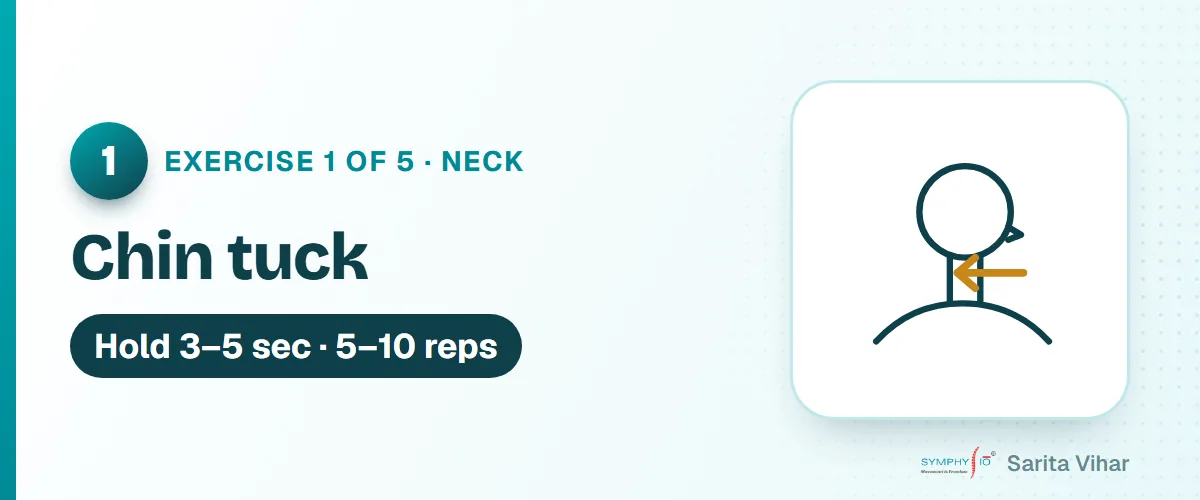
How to do it: Sit upright and look straight ahead. Gently draw your chin backwards, as though making a small double chin, without tilting your head down.
Repetitions: Hold for 3–5 seconds; repeat 5–10 times.
Safety note: Stop if the movement causes dizziness, sharp pain or tingling that spreads into your arm.
2. Gentle neck rotation
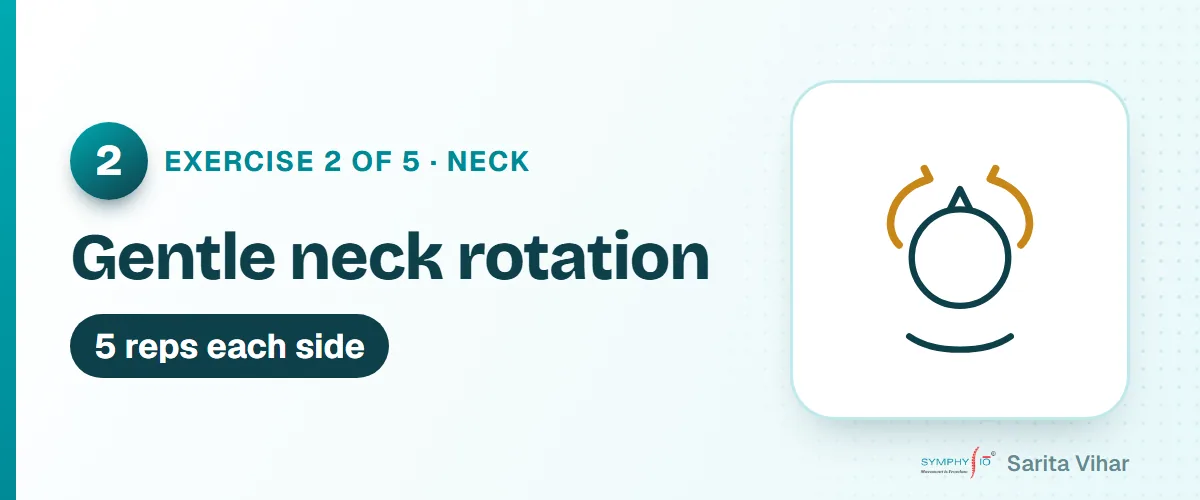
How to do it: Sit comfortably with your shoulders relaxed. Slowly turn your head a little to one side, return to the centre, then repeat on the other side.
Repetitions: 5 repetitions on each side.
Safety note: Avoid forcing the movement or pushing through pain. Do not practise this exercise if turning your head triggers unexplained spinning.
3. Shoulder blade squeezes
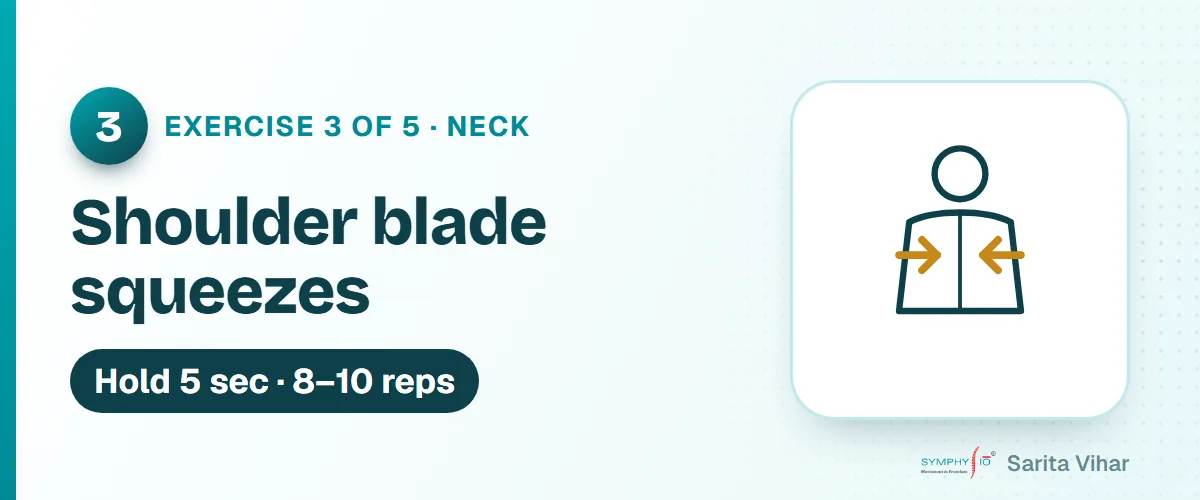
How to do it: Sit or stand tall. Gently draw your shoulder blades towards each other without shrugging your shoulders or arching your lower back.
Repetitions: Hold for 5 seconds; repeat 8–10 times.
Safety note: Keep the movement comfortable and stop if it increases neck or arm symptoms.
4. Gentle shoulder rolls
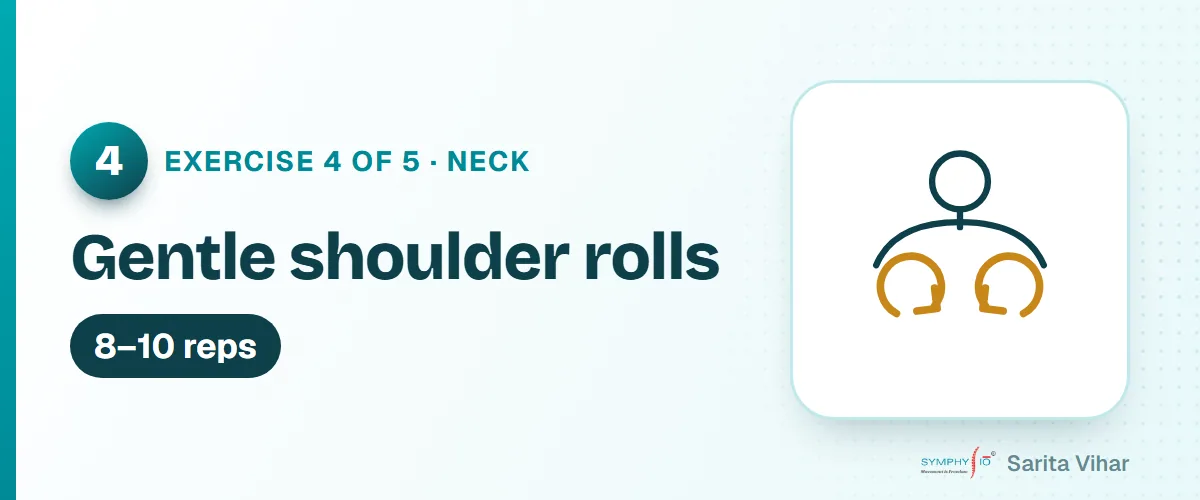
How to do it: Sit or stand with your arms relaxed. Slowly roll your shoulders backwards in a small, comfortable circle, then relax.
Repetitions: 8–10 repetitions.
Safety note: Avoid large, forceful circles and stop if the movement causes pain or dizziness.
5. Gentle neck isometric exercise
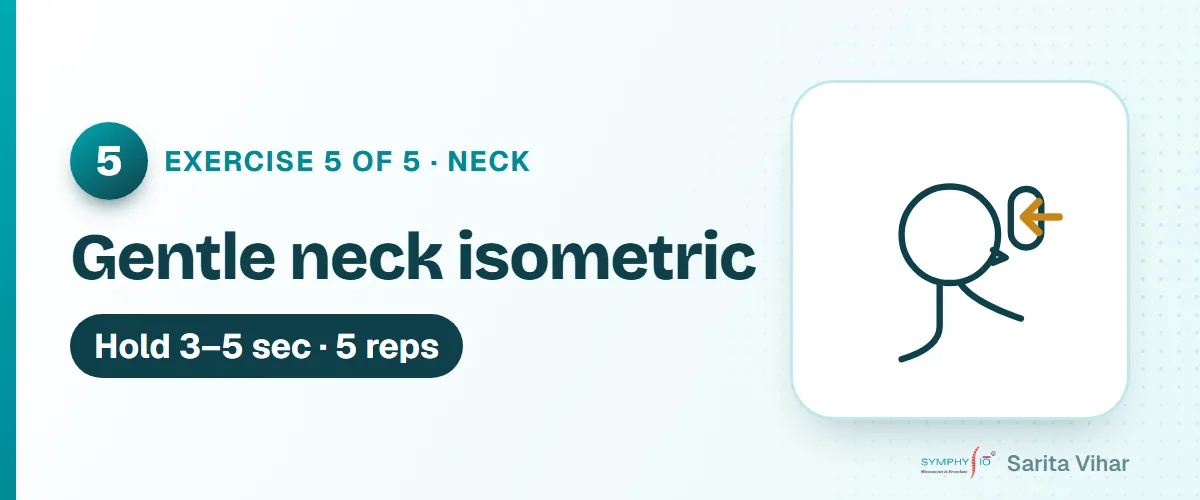
How to do it: Sit upright. Place your palm against your forehead and gently press your head into your hand without allowing your head to move. Keep the effort light.
Repetitions: Hold for 3–5 seconds; repeat 5 times.
Safety note: Avoid this exercise until assessed if you have significant neck pain, recent trauma, neurological symptoms or unexplained dizziness.
Important: Stop exercising if you develop new numbness, weakness, severe pain or dizziness. Seek medical advice if symptoms persist or worsen. Your physiotherapist can modify or replace exercises according to your condition.
Daily habits that protect your neck
Small daily changes can complement your physiotherapy programme.
- Choose a supportive pillow: Keep your head and neck reasonably aligned with your spine. Pillow height depends on your sleeping position and body shape.
- Sleep comfortably: Back or side sleeping often allows a neutral neck position. Avoid forcing yourself into a position that causes discomfort.
- Raise your screen: Position your monitor near eye level so you do not need to look down continuously.
- Adjust phone use: Bring your phone closer to eye level and support your arms when possible.
- Take movement breaks: Stand up, walk briefly and change position regularly rather than sitting in one posture for hours.
- Stay active: Continue comfortable daily movement and build exercise gradually.
- Avoid self-manipulation: Do not forcefully twist or crack your neck, particularly if dizziness is present.
A cervical collar is not routinely needed for long-term cervical spondylosis. Prolonged use without medical advice may reduce muscle activity and should be avoided unless specifically recommended.
If your neck pain keeps returning despite temporary relief, our guide on why neck pain keeps coming back explains why a broader rehabilitation plan may help.
How long does recovery take?
Recovery depends on the severity of your symptoms, the cause of your dizziness, your general health and how consistently you can follow an appropriate treatment plan.
As a broad guide, some people with uncomplicated muscular neck pain notice improvement over a few weeks. More persistent symptoms may require several weeks to a few months of progressive rehabilitation. Nerve-related symptoms or complex balance problems may need additional investigation and a longer recovery period.
These are general estimates, not guarantees. Age-related changes visible on scans may remain even when your pain and function improve.
Your physiotherapist should review your progress and adjust the plan if improvement is limited. If symptoms worsen or new neurological signs appear, further medical assessment may be needed.
For a clearer understanding of your symptoms, read our article on why an MRI does not always explain your pain.
Cervical spondylosis treatment in Sarita Vihar at Symphysio
If neck stiffness, headaches or dizziness are affecting your daily routine, Symphysio offers physiotherapy and rehabilitation services in Sarita Vihar, New Delhi.
Our approach focuses on understanding your symptoms, identifying relevant movement and functional limitations, and selecting treatment according to your individual needs.
What happens during your first visit?
Your first appointment generally involves:
- Discussion of your symptoms: When they started, what makes them worse, and whether you experience dizziness, headaches or arm symptoms.
- Clinical assessment: Your physiotherapist may examine neck mobility, posture, muscle function and relevant neurological or balance findings.
- Treatment planning: You will discuss appropriate treatment options, expected progress and whether medical referral is necessary.
- Guidance for home: Where suitable, you may receive advice on activity modification, exercises and workplace ergonomics.
Not every patient needs manual therapy, dry needling or chiropractic adjustment. Treatment is selected according to clinical findings, preferences and safety considerations.
Why consider Symphysio?
- Individualised assessment rather than relying on scan findings alone.
- Rehabilitation options that may include manual therapy, exercise and posture correction.
- Education to help you understand and manage your symptoms.
- A focus on improving everyday activities, movement and functional confidence.
We welcome people seeking cervical physiotherapy in Sarita Vihar and from nearby areas, including Jasola, Kalindi Kunj, Madanpur Khadar, Okhla, Sukhdev Vihar, New Friends Colony, Badarpur and Kalkaji.
If you are searching for cervical pain treatment near me, explore neck and cervical pain physiotherapy in Sarita Vihar.
Choosing the best physiotherapist in Sarita Vihar for your needs means looking for an appropriately qualified professional who explains the assessment, discusses treatment options and recognises when medical referral is needed. If you are searching for a physiotherapy clinic near me in South Delhi, consider whether the clinic offers an individual assessment and a clear rehabilitation plan.
To discuss an appointment, visit the Symphysio booking page.
Conclusion: Get the right cervical spondylosis treatment
Neck stiffness, headaches and dizziness can make everyday activities difficult, but these symptoms do not automatically mean you have a serious cervical spine problem. The important first step is identifying the cause, particularly when dizziness is new, persistent or unexplained.
Appropriate cervical spondylosis treatment may include physiotherapy, progressive exercises, posture adjustments and medical care when required. The best plan depends on your symptoms and assessment findings, not simply your age or MRI report.
At Symphysio, Sarita Vihar, our team can assess your neck movement and functional concerns, explain suitable rehabilitation options and help you understand when further medical evaluation is needed.
Phone / WhatsApp: +91 76783 89399 · Chat on WhatsApp
Medical disclaimer: This article is for general educational purposes only and does not replace individual medical advice, diagnosis or treatment. Dizziness may have causes unrelated to the cervical spine. Seek medical assessment for new or persistent symptoms and emergency care for sudden dizziness accompanied by neurological warning signs. Perform exercises only when appropriate for your condition and stop if symptoms worsen.
Frequently Asked Questions
It may be associated with cervicogenic dizziness in some people, particularly when neck pain and movement-related symptoms occur together. However, dizziness has many possible causes, so a clinician should assess other explanations before attributing it to the neck.
Neck pain, stiffness and dizziness that occur together may suggest a connection, but these symptoms alone cannot confirm the cause. A clinical assessment should consider inner-ear disorders, migraine, blood pressure changes and neurological conditions.
Neck-related dizziness is not always dangerous, but unexplained dizziness should not be ignored. Sudden vertigo with facial drooping, slurred speech, double vision, weakness or difficulty walking requires emergency care.
There is no single fastest cure because treatment depends on the cause. Appropriate medical assessment followed by targeted treatment, which may include physiotherapy or vestibular rehabilitation, is safer than trying forceful neck exercises or manipulation.
The number varies according to your symptoms, examination findings, goals and response to treatment. Your physiotherapist should review progress regularly and agree on a suitable plan rather than promise a fixed number of sessions.
Back or side sleeping may be comfortable when your pillow keeps your neck reasonably aligned with your spine. There is no single best position for everyone, so choose one that supports comfortable sleep without aggravating your symptoms.
A cervical collar is not routinely recommended for long-term use in uncomplicated cervical spondylosis. Use one only when advised for a specific clinical reason, as unnecessary prolonged use may contribute to reduced neck muscle activity.
Many people manage symptoms without surgery through appropriate activity, exercise, physiotherapy and medical care when needed. Degenerative changes may not disappear, but pain, movement and everyday function can improve. Surgery may be considered in selected cases involving significant nerve or spinal cord compression.
- Cervical Spondylosis
- Neck Pain
- Cervical Vertigo
- Physiotherapy
- Sarita Vihar
- Dizziness
- Posture Correction
- Neck Exercises
References
These sources provide background guidance and research. Evidence and suitability vary by condition and technique; discuss benefits, risks and alternatives with your clinician.
General health information cannot diagnose your symptoms or replace individual medical advice. Do not delay urgent care for concerning symptoms. Read our medical disclaimer.
Book an assessment at Symphysio
Talk to our team in Sarita Vihar and get a plan built around your symptoms, not a fixed protocol.