Stroke Recovery After Discharge: A Family's Guide to Physiotherapy in Sarita Vihar
Stroke physiotherapy in Sarita Vihar: recovery phases, safe home exercises and caregiver guidance for families. Speak to Symphysio's neuro-rehab team.

Written by Dr. Rahul Bhandari, PT, MPT (Sports)
Published October 21, 202615 min read
In this article
Your loved one is home from the hospital, and now you are wondering what comes next. Perhaps one arm is still weak, walking feels difficult, or everyday activities such as getting out of bed require help. You may be relieved that the hospital stay is over, yet unsure how to support recovery safely.
Stroke physiotherapy can be an important part of rehabilitation after discharge. It helps stroke survivors practise movement, improve balance, build strength and work towards greater independence, according to their individual abilities.
At Symphysio, in Sarita Vihar, New Delhi, we understand that stroke recovery affects the entire family. In this guide, we explain what happens after a stroke, when rehabilitation should begin, which exercises may be appropriate, how caregivers can help and what to expect from neuro-rehabilitation.
Recovery looks different for everyone. The aim is to make progress safely, celebrate meaningful improvements and build a practical plan around your loved one's needs.
Key takeaways
- Begin rehabilitation as soon as the treating medical team confirms it is safe.
- Stroke recovery can continue beyond the first six months, although progress and outcomes vary.
- Physiotherapy may help improve transfers, walking, balance, arm function and everyday independence.
- Caregiver training and a safer home environment are important parts of rehabilitation.
- Seek emergency care immediately if stroke symptoms appear suddenly or return.
What happens to the body after a stroke?
A stroke, sometimes called a brain attack, occurs when blood flow to part of the brain is interrupted or when bleeding damages brain tissue. The two main types are ischaemic stroke, caused by a blocked blood vessel, and haemorrhagic stroke, caused by bleeding in or around the brain.
The brain controls movement, sensation, coordination, speech and many other functions. When a stroke damages the areas responsible for these activities, a person may experience changes that affect daily life.
Common difficulties include:
- Hemiparesis: weakness affecting one side of the body.
- Paralysis: inability to move some muscles voluntarily.
- Balance problems: difficulty sitting upright, standing or walking safely.
- Reduced hand function: trouble holding a cup, buttoning clothes or using a phone.
- Speech and communication difficulties: difficulty speaking, understanding words or finding the right words.
- Changes in sensation: reduced awareness of touch or the position of an arm or leg.
- Spasticity: increased muscle stiffness that can make movement difficult.
Some survivors also experience shoulder pain, foot drop or fatigue. The combination and severity of symptoms depend on the location and extent of the brain injury.
How does the brain learn movement again?
The brain has an ability called neuroplasticity. In simple terms, it can adapt by strengthening existing connections and developing new patterns of activity through learning and practice.
Think of rehabilitation like learning a new route. Repeated, purposeful practice helps the brain and body become more efficient at performing a task.
This does not mean every function will return completely. However, appropriately selected, repeated activities can help many survivors improve movement and independence over time.
Why the first 3–6 months matter most
The first three to six months after a stroke are often an important period for recovery. Many survivors make noticeable gains during this time as the brain recovers from the initial injury and rehabilitation helps them practise everyday movements.
You may hear this period described as the stroke recovery "golden period". It is an informal term, not a deadline after which recovery stops.
Progress depends on the type and severity of the stroke, the person's medical condition, the abilities affected and access to suitable rehabilitation. Recovery may involve small changes, such as improved sitting balance, or larger functional gains, such as walking with an appropriate aid.
Improvement can continue after six months and even years later. Progress may become slower, and goals may change, but ongoing rehabilitation can still support mobility, strength, participation and independence.
The important step is to set realistic goals and review them regularly rather than compare your loved one with another person's recovery.
For an overview of rehabilitation services, visit neurological rehabilitation at Symphysio.
How soon should stroke physiotherapy start?
Rehabilitation should begin as early as the treating medical team considers safe. The right timing depends on the person's stability, stroke severity, complications and ability to tolerate activity.
Some patients begin carefully supervised rehabilitation in hospital. After discharge, the hospital team or treating neurologist may recommend continuing with outpatient or home-based rehabilitation.
Before starting or increasing activity, confirm any movement restrictions and precautions with the medical team. Early rehabilitation does not mean forcing someone to stand or walk before they are ready.
A physiotherapist can assess what your loved one can safely do, help you understand the next steps and coordinate with the treating neurologist when needed.
For further information, consult the NHS guide to stroke recovery and the American Stroke Association's stroke recovery resources.
Warning signs: call emergency services immediately
If your loved one develops sudden new neurological symptoms, do not assume they are part of the previous stroke. A new stroke or another serious condition may be responsible.
Remember BE FAST:
- B — Balance: sudden loss of balance, coordination or ability to walk.
- E — Eyes: sudden loss of vision, blurred vision or double vision.
- F — Face: one side of the face suddenly droops.
- A — Arms: sudden weakness or numbness in an arm or leg, especially on one side.
- S — Speech: slurred speech, difficulty speaking or difficulty understanding others.
- T — Time: call emergency services immediately and note when symptoms started.
In India, call 112 for emergency assistance or 102 for ambulance services where available. Do not wait to see whether the symptoms improve, and do not give food, drink or medication to someone who may be having an acute stroke unless directed by emergency professionals.
Even if the symptoms disappear after a few minutes, urgent medical assessment is still necessary.
What stroke rehabilitation at our clinic includes
Stroke rehabilitation should be tailored to the person's current abilities, medical precautions, goals and home environment. At Symphysio, the assessment guides which interventions are suitable and how they should progress.
1. Detailed neurological assessment
Your physiotherapist reviews movement, strength, muscle tone, sensation, posture, coordination, balance and functional abilities. They may also assess how much assistance your loved one needs during daily tasks.
The assessment helps establish a starting point and identify practical goals, such as sitting independently, transferring to a chair or improving walking safety.
2. Bed mobility and transfers
After a stroke, turning in bed, sitting up and moving from bed to chair may require assistance. Rehabilitation can include practising these tasks with suitable techniques and equipment.
Caregivers can also learn how to provide support without pulling the affected arm or placing themselves at risk of injury.
3. Sitting and standing balance
Balance training may begin with supported sitting and progress towards standing or reaching activities when safe.
Exercises are selected according to the person's control and confidence. The aim is to improve stability for everyday tasks and reduce the risk of falls.
4. Gait training and walking aids
For survivors working towards walking after stroke, gait training may focus on weight shifting, stepping, coordination and safe movement.
A walker, walking stick or ankle-foot orthosis (AFO splint) may be appropriate for some people. The correct device and level of assistance should be determined through assessment rather than purchased without guidance.
5. Arm and hand function
Physiotherapy may include reaching, supported arm movement, grasp-and-release practice and tasks that encourage useful hand function.
Progress can be gradual, especially when the affected arm has limited movement. An occupational therapist may also help with daily activities, adaptive equipment and strategies for dressing, bathing and eating.
6. Managing spasticity and stiffness
Some survivors develop increased muscle tone that makes the arm, wrist, fingers or leg feel stiff. Spasticity management may involve positioning, guided movement, stretching where appropriate and task-specific exercises.
Severe or painful spasticity may require review by a doctor or specialist team. Medication or other interventions may be considered alongside rehabilitation when clinically indicated.
7. Preventing shoulder pain and falls
A weak shoulder needs careful handling. Pulling on the affected arm during transfers can cause pain or injury, so caregivers should learn safe support techniques.
Fall prevention may include balance practice, suitable walking aids, footwear advice and changes to the home environment. Rehabilitation may also be coordinated with speech therapy, occupational therapy and medical care when the person needs broader support.
You can explore the clinic's therapist information to learn more about the team.
Stroke recovery phases
These timeframes are general guides, not fixed rules. The phase and pace of recovery depend on the person's medical status, stroke severity and functional needs.
| Phase | Typical timeframe | Main goals | What physiotherapy focuses on |
|---|---|---|---|
| Acute care | First hours to days | Stabilise the patient and manage urgent medical needs | Rehabilitation begins only when the medical team considers activity safe |
| Early rehabilitation | Days to weeks | Regain safe movement and begin everyday tasks | Positioning, bed mobility, sitting balance and supported transfers |
| Subacute recovery | Weeks to around 3–6 months | Build mobility, strength and functional independence | Repetitive task practice, balance, gait training and arm-hand activities |
| Ongoing rehabilitation | After 6 months | Maintain abilities and work towards further functional gains | Goal-based practice, community mobility, daily activities and fall prevention |
A person may move between goals or need support from several professionals at once. Rehabilitation should be reviewed regularly and adjusted as abilities or health needs change.
Home physiotherapy vs clinic sessions: which is better?
Both settings can be useful. The best choice depends on mobility, medical needs, transport, home safety and the type of equipment or support required.
| Consideration | Home physiotherapy | Clinic physiotherapy |
|---|---|---|
| Main advantage | Practice in the actual home environment and train caregivers in everyday tasks | Access to a dedicated treatment space and equipment when available |
| Useful for | People who have difficulty travelling or need help with bed mobility and transfers | People able to travel safely who benefit from a structured rehabilitation setting |
| Limitations | Space and equipment may be limited; suitability depends on whether home visits are offered | Travel and transfers may be tiring or difficult |
| Best approach | Often helpful for functional practice and home-safety planning | May support progressive training and access to clinic resources |
Many families combine home-based practice with clinic sessions. Ask the clinic whether home visits are available before arranging care; availability should be confirmed directly with Symphysio.
5 safe stroke recovery exercises to do at home
Start these exercises only after a physiotherapist has assessed your loved one and confirmed that each activity is appropriate. The correct position, assistance and number of repetitions vary considerably after stroke.
Do not attempt standing or walking exercises without the recommended support if your loved one has poor balance or cannot follow safety instructions.
1. Supported ankle movements
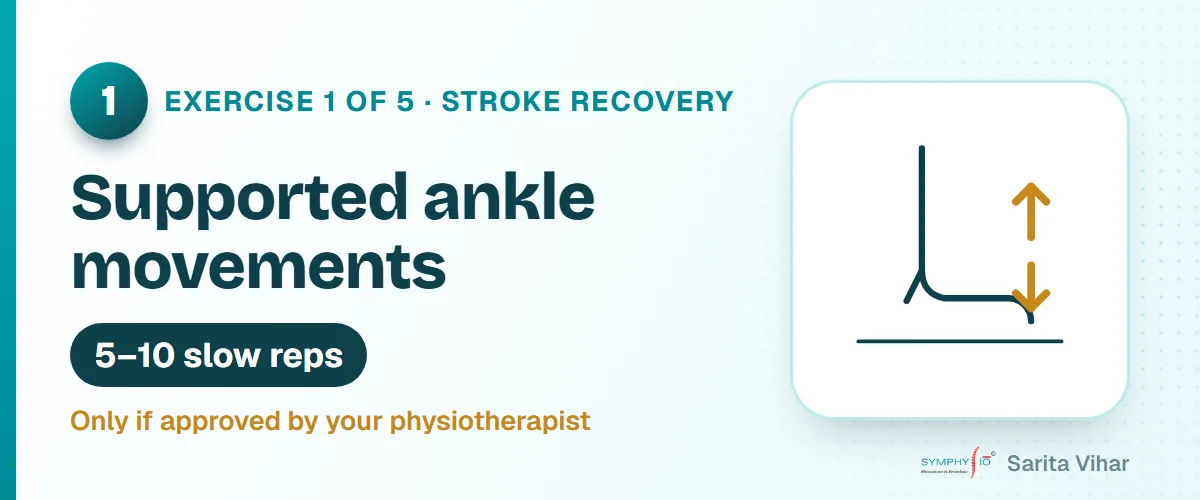
How to do it: With the person seated or lying comfortably, help them gently move the ankle up and down within a comfortable range, if they can tolerate the movement.
Starting amount: Try 5–10 slow repetitions, only if approved by the physiotherapist.
Caregiver tip: Support the leg comfortably and allow the person to do as much of the movement as they safely can.
Safety note: Do not force the ankle or continue if it causes pain. Ask the clinician about foot drop or the need for an AFO.
2. Supported knee bending in bed
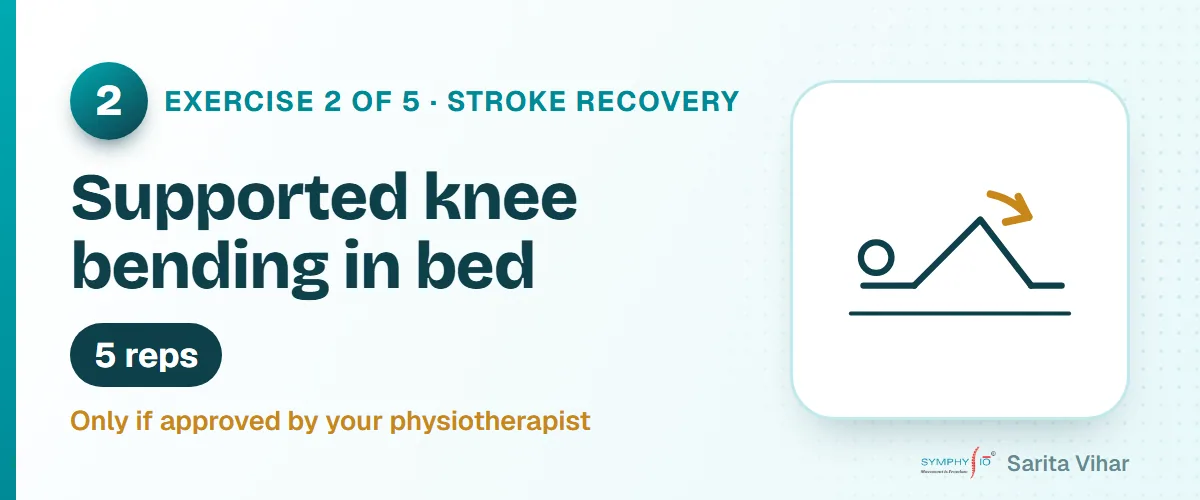
How to do it: While lying on the bed, the person gently bends and straightens one knee. A caregiver or therapist may support the affected leg if instructed.
Starting amount: 5 repetitions, within the person's comfortable range.
Caregiver tip: Use a stable bed and follow the therapist's instructions for supporting the affected leg.
Safety note: Stop if there is pain, unusual breathlessness or marked fatigue. Do not pull the leg to force a bend.
3. Seated weight shifting
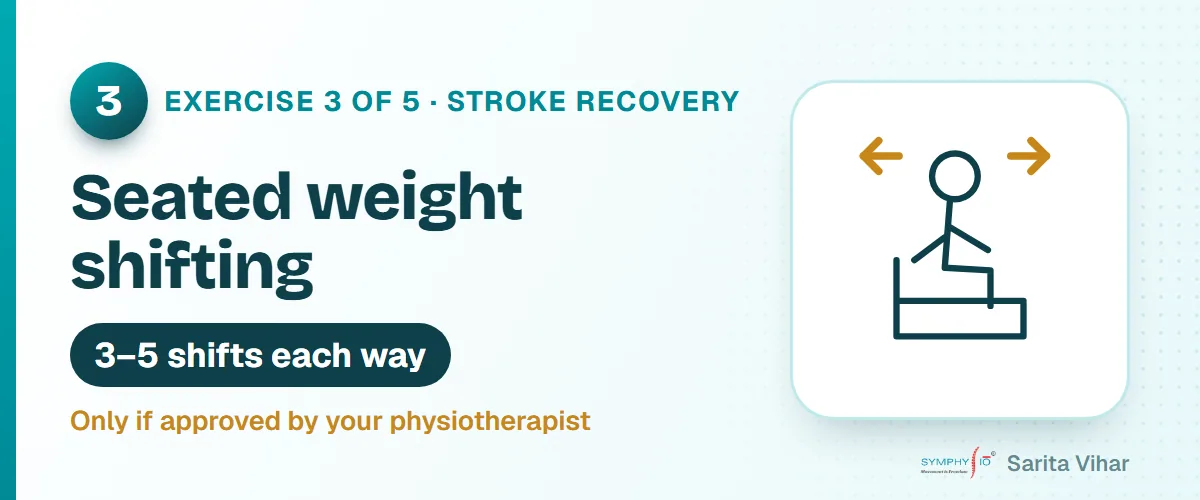
How to do it: With the person sitting securely and a trained helper nearby, practise gently shifting the body a small distance from side to side and returning to the centre.
Starting amount: 3–5 gentle shifts in each direction, if approved.
Caregiver tip: Keep the chair stable and follow the physiotherapist's guidance on how much support is needed.
Safety note: Do not practise if the person cannot sit safely, becomes dizzy or is at risk of falling from the chair.
4. Supported sit-to-stand practice
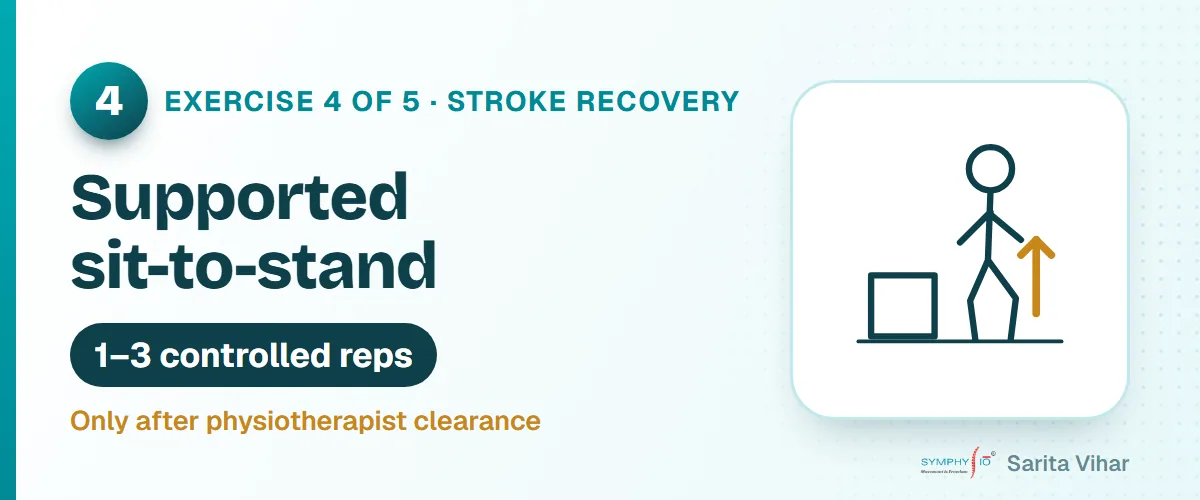
How to do it: Only when cleared by the physiotherapist, practise standing up from a firm, suitable chair with the prescribed level of assistance and walking aid, if needed.
Starting amount: Begin with 1–3 controlled repetitions or the amount recommended by the therapist.
Caregiver tip: Learn the correct assistance technique in person. Do not pull the affected arm or lift the person by the shoulders.
Safety note: Skip this exercise unless the therapist has confirmed it is safe. A person with poor balance or significant weakness may need specialist equipment or more assistance.
5. Supported reaching with the affected arm
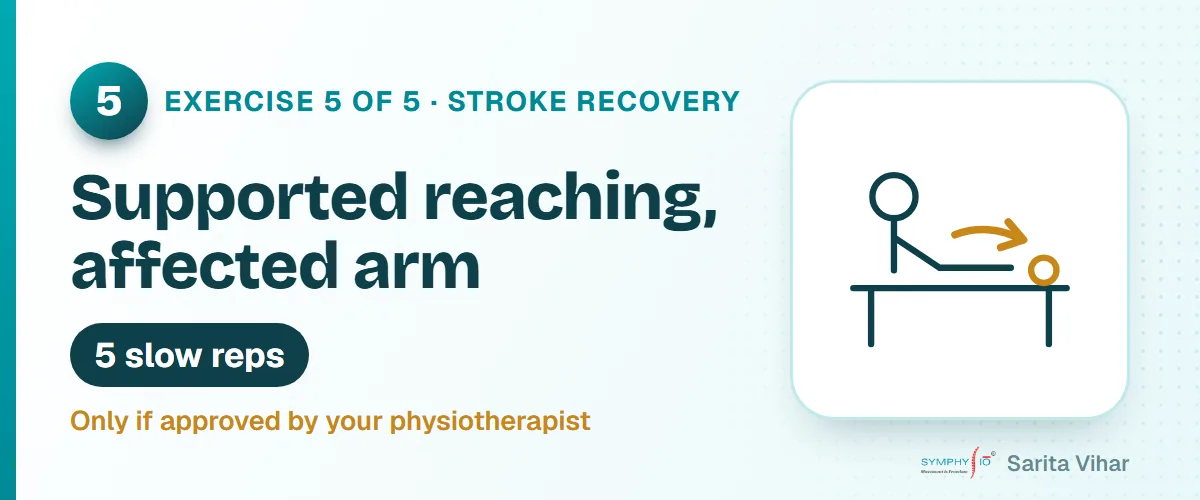
How to do it: With the affected arm comfortably supported on a table or cushion, practise a small forward reach towards a lightweight object, if the therapist recommends it.
Starting amount: 5 slow repetitions, staying within a comfortable range.
Caregiver tip: Support the arm and shoulder as instructed, and encourage active movement without forcing it.
Safety note: Never pull the arm or push through shoulder pain. Seek clinical advice if shoulder pain or swelling develops.
Exercises are only one part of rehabilitation. Follow the programme given by the treating team, allow rest breaks and stop if your loved one develops new symptoms, pain or unusual fatigue.
A caregiver's checklist
Your support can make rehabilitation safer and more consistent, but you do not have to do everything alone.
- Make the home safer: Clear walkways, secure loose rugs, improve lighting and keep frequently used items within reach.
- Position the affected arm carefully: Support it on a pillow or appropriate surface. Never lift or pull your loved one by that arm.
- Reduce pressure injury risk: Follow clinical advice about repositioning, skin checks and pressure-relieving equipment if the person spends long periods in bed or a chair.
- Practise safe transfers: Ask a physiotherapist to demonstrate bed-to-chair transfers and show you when one or more helpers are needed.
- Use equipment correctly: Follow advice about a wheelchair, walker, AFO or other prescribed support.
- Encourage without pressure: Celebrate effort and small functional gains. Allow extra time for tasks and respect your loved one's preferences.
- Coordinate care: Keep medication instructions, follow-up appointments and emergency contact details accessible. Arrange speech or occupational therapy assessments when recommended.
- Look after yourself: Share care duties where possible, take breaks and ask the healthcare team for help when tasks feel unsafe or overwhelming.
How long does stroke recovery take?
There is no single recovery timeline. Some people make rapid early gains, while others need months or longer to develop new skills or adapt to lasting changes.
Several factors influence progress:
- Stroke type and severity: The location and extent of brain injury affect which abilities are changed.
- General health and age: Other medical conditions, fatigue and overall fitness may influence participation in rehabilitation.
- Timing and continuity of rehabilitation: Starting when medically safe and practising regularly can support progress.
- Consistency and task practice: Repeated, relevant practice helps build skills, provided it is safe and appropriately challenging.
- Family and social support: Encouragement, caregiver training and access to services can make it easier to continue a programme.
Recovery goals may include walking with an aid, using the affected hand more effectively, transferring with less help or performing daily activities more independently. Full recovery cannot be promised, and improvement in one area does not guarantee the same progress in another.
Your physiotherapist should discuss measurable goals with you and review them over time. If progress changes unexpectedly or new symptoms appear, contact the treating medical team.
Stroke physiotherapy in Sarita Vihar at Symphysio
If your loved one has recently been discharged and needs continued rehabilitation, Symphysio provides physiotherapy and rehabilitation services in Sarita Vihar, New Delhi. The appropriate programme depends on clinical assessment and the person's discharge instructions.
What happens at the first visit?
The first visit usually includes a discussion of the stroke history, current abilities, discharge advice, medicines and any movement precautions. Your physiotherapist may assess strength, muscle tone, transfers, sitting balance, standing, walking and arm function, as appropriate.
Together, you can identify priorities for the coming weeks. These might include sitting safely, getting from bed to chair, improving walking with an aid or practising selected daily activities.
Caregivers can ask questions and learn how to assist safely. If a person's symptoms or medical needs fall outside the scope of physiotherapy, referral to the treating doctor or another professional may be recommended.
A coordinated approach to rehabilitation
Stroke recovery can involve a team. Depending on the person's needs, the physiotherapist may coordinate care with the treating neurologist, rehabilitation physician, occupational therapist, speech and language therapist or other healthcare professionals.
A clear plan should account for fatigue, pain, communication difficulties, home safety and the person's own goals. The clinic should also explain what can realistically be addressed in physiotherapy and what requires other medical care.
Symphysio serves Sarita Vihar and nearby areas, including Jasola, Kalindi Kunj, Madanpur Khadar, Okhla, Sukhdev Vihar, New Friends Colony, Badarpur, Kalkaji, Govindpuri, CR Park and Tughlakabad.
If you are searching for stroke rehabilitation Sarita Vihar, paralysis treatment physiotherapy or neuro physiotherapy South Delhi, you can read about our Sarita Vihar services or explore neurological rehabilitation.
To discuss suitability, appointment options and whether home visits are available, contact the clinic directly. You can also review our rehabilitation team and book an appointment.
Take the next step with stroke physiotherapy in Sarita Vihar
After a stroke, families often have many questions and no single recovery path to follow. A clear rehabilitation plan can help you understand what is safe now, what to practise and which goals matter most to your loved one.
Stroke physiotherapy may support progress with movement, balance, transfers, hand function and everyday activities. The right approach depends on an individual assessment, medical advice and realistic goals.
Symphysio in Sarita Vihar can help you discuss rehabilitation options and plan the next step with your family. Contact the clinic to ask about availability, assessment and whether home visits are offered.
Phone / WhatsApp: +91 76783 89399 · Chat on WhatsApp
Medical disclaimer: This article provides general educational information and does not replace advice from the treating neurologist or other healthcare professionals. Do not start or change rehabilitation exercises without appropriate clinical guidance. Sudden new or returning stroke symptoms require emergency assessment; call 112 or 102 where available.
Frequently Asked Questions
Rehabilitation should start as early as the medical team considers safe, sometimes during the hospital stay. After discharge, follow the treating neurologist's advice and arrange an assessment to establish suitable activities and precautions.
Some stroke survivors regain walking ability or improve their walking with support, while others continue to need assistance or a wheelchair. Outcomes depend on factors such as stroke severity, balance, strength, other medical conditions and rehabilitation needs; no one can guarantee a particular result.
Recovery varies widely. Many people make important gains in the first months, and further improvement can continue beyond six months with appropriate practice and support.
There is no fixed number that suits everyone. Session frequency and duration depend on medical stability, goals, tolerance, progress and the overall rehabilitation plan agreed with the healthcare team.
Home visits can help with transfers, caregiver training and practising tasks in the actual home environment. Clinic sessions may offer a dedicated space and equipment; some people benefit from a combination, depending on availability and clinical needs.
Suitable activities may include supported limb movements, sitting balance and task-specific practice, but exercises must be selected after an individual assessment. Do not start standing or walking exercises without appropriate clearance and assistance.
Shoulder pain can occur because of weakness, altered muscle tone, reduced movement or poor support of the affected arm. Avoid pulling the arm and seek assessment so the cause can be identified and a safe positioning and movement plan can be provided.
Yes. Improvement can continue beyond six months and sometimes for years, although the pace and extent differ between individuals. Rehabilitation can still focus on functional skills, maintaining movement, preventing complications and improving participation in everyday life.
- Stroke Rehabilitation
- Stroke Physiotherapy
- Paralysis Rehabilitation
- Neuro Physiotherapy
- Sarita Vihar
- Gait Training
- Balance Training
- Caregiver Support
References
These sources provide background guidance and research. Evidence and suitability vary by condition and technique; discuss benefits, risks and alternatives with your clinician.
General health information cannot diagnose your symptoms or replace individual medical advice. Do not delay urgent care for concerning symptoms. Read our medical disclaimer.
Book an assessment at Symphysio
Talk to our team in Sarita Vihar and get a plan built around your symptoms, not a fixed protocol.