Why Does My MRI Not Always Explain My Pain?
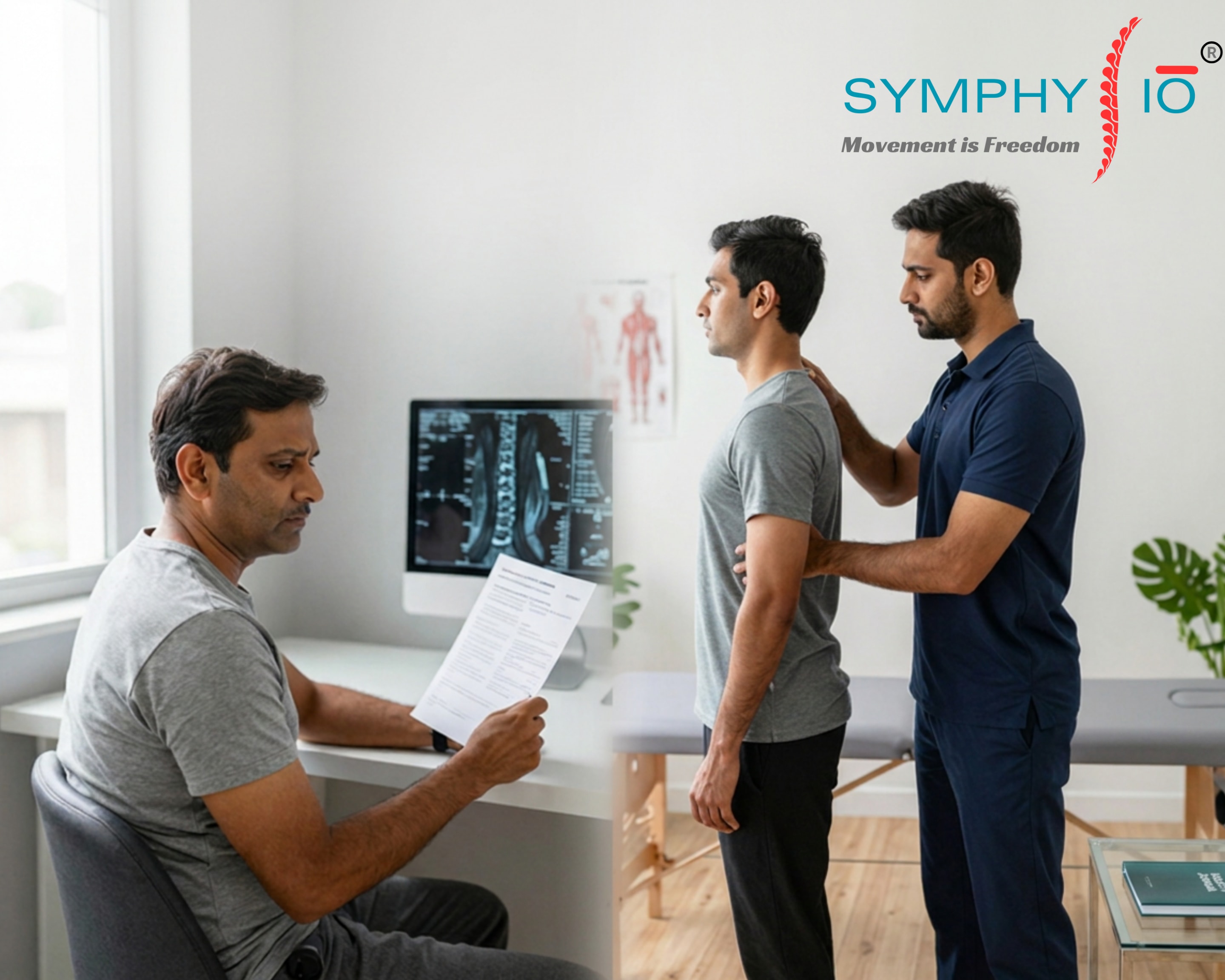
Imaging findings and symptoms do not always match directly. A clinician considers the history and examination alongside a scan; this does not mean an MRI.

Written by Dr. Rahul Bhandari, PT, MPT (Sports)
Published July 28, 2026Last updated October 14, 20264 min read
In this article
Imaging findings and symptoms do not always match directly. A clinician considers the history and examination alongside a scan; this does not mean an MRI finding should be ignored without medical advice.
For an individual assessment, see our back pain assessment and care.
What an MRI Can — and Can't — Tell You
MRI is a genuinely valuable diagnostic tool. It provides detailed images of:
- Spinal discs
- Muscles and tendons
- Ligaments
- Cartilage and joints
- Other soft tissues
It plays an important role in ruling out serious pathology and supporting medical decisions. What it doesn't show is how your joints actually move, whether your muscles are activating in the right sequence, how your posture and daily movement patterns affect your symptoms, or whether you're unconsciously compensating for an old injury. This is exactly why an MRI report should always be read alongside a detailed physiotherapy evaluation — whether you're looking for back pain treatment in Sarita Vihar, neck pain physiotherapy near Jasola, or sports injury rehabilitation anywhere in South Delhi, a movement-based assessment is what actually guides long-term recovery.
Why Two People With the Same MRI Report Can Have Different Pain Levels
One of the most misunderstood facts about pain is that MRI findings and symptoms don't always match. Plenty of people with zero pain have mild disc bulges, age-related degenerative changes, tendon changes, or joint wear visible on imaging. At the same time, someone in significant pain may show no major structural abnormality at all.
Pain is influenced by far more than tissue structure — movement patterns, tissue sensitivity, past injuries, strength and flexibility, workload and posture, activity levels, sleep, stress, and how the nervous system itself has adapted all play a role. This is why treating the person — not just the line in the MRI report — is the foundation of effective physiotherapy.
What a Clinical Assessment at Symphysio Actually Involves
A proper physiotherapy assessment looks well beyond the painful area itself. At our Sarita Vihar clinic, we build a picture of the relationship between your symptoms, your movement, and your day-to-day life.
Movement and gait analysis
How your body performs everyday movements — walking, bending, lifting, squatting, running, or a sport-specific action — often reveals more than any scan.
Joint mobility evaluation
We check for movement restrictions in the joints above and below the painful area, since a stiff hip or ankle often shows up as pain somewhere else entirely.
Strength and movement-control testing
Identifying where muscles aren't supporting a movement efficiently, so weak or poorly timed muscle activity gets addressed directly rather than guessed at.
Functional and lifestyle review
Understanding how the pain actually shows up in your work, exercise routine, sport, or daily lifestyle, since a desk job and a competitive sport demand very different rehab plans.
Previous injury history
Old injuries, surgeries, or the movement adaptations that followed them often quietly influence a patient's current symptoms years later.
When to See a Physiotherapist Instead of Just Repeating a Scan
A few signs it's time for a movement-based assessment rather than another round of imaging:
- Your pain persists despite a scan reading as "normal" or only "mild"
- The severity of your pain doesn't seem to match what the report describes
- Pain keeps returning after treatment that only ever addressed the imaging finding
- You've been told to "just rest" with no explanation of what to do differently
- You're avoiding activities out of fear of the word used in your report, not because of an actual limitation
Getting an Accurate Diagnosis: What to Do Before and After Your MRI
- Don't judge severity by the words in the report alone — "degeneration" and "bulge" appear on plenty of pain-free scans
- Ask for a physiotherapy movement assessment alongside imaging, not only after other options are exhausted
- Track when your pain actually gets better or worse — activity, posture, and time of day tell a physiotherapist more than a single image
- Bring your imaging report to your physiotherapy appointment so findings and function can be compared directly
Physiotherapy Near Apollo Hospital, Sarita Vihar
An MRI report is a valuable piece of information — but it's only one part of the picture. Understanding movement, function, and your individual history is what actually drives recovery. Symphysio Physiotherapy Clinic, based in Sarita Vihar next to Apollo Hospital, sees patients from across Jasola, Okhla, Sukhdev Vihar, New Friends Colony, Kalindi Kunj, and Badarpur for exactly this kind of assessment-led, movement-focused physiotherapy care.
"Evidence-informed physiotherapy. Personalised rehabilitation. Movement is Freedom."
Discuss your symptoms with a physiotherapist
If symptoms affect everyday activity, explore assessment and physiotherapy options or book an appointment. This information cannot diagnose your symptoms; read our medical disclaimer.
Frequently Asked Questions
No. Pain can be very real even when imaging looks unremarkable, because MRI shows structure, not function. A normal scan simply means there's no major structural pathology visible — it doesn't rule out movement restrictions, muscle imbalances, or nerve sensitivity, all of which a physiotherapy assessment is specifically designed to pick up.
Studies consistently find disc bulges and age-related degenerative changes on the scans of people with no back pain at all. These findings are often a normal part of ageing rather than the direct cause of symptoms, which is exactly why the report needs to be interpreted alongside a clinical movement assessment, not read in isolation.
Yes. Degenerative changes are common and often not the main driver of pain. Physiotherapy focuses on improving how the joint moves, how surrounding muscles support it, and how you load it during daily activity — all of which can meaningfully reduce pain regardless of what the scan shows.
Not necessarily. Many patients benefit from a physiotherapy assessment first, since it's often what determines whether imaging is even needed. If you do have a scan already, bring it along — we'll interpret it alongside a full movement and functional assessment rather than treating the report on its own.
A radiologist's report describes what the tissue looks like in a static image. A physiotherapy assessment looks at how you actually move, how your joints and muscles behave under load, your posture, your history, and your daily demands — building a functional picture that a still image can't capture on its own.
If you have red-flag symptoms — significant unexplained weight loss, night pain that doesn't ease with rest, loss of bladder or bowel control, fever, or progressive neurological symptoms like numbness or weakness — see a doctor immediately. For everyday persistent musculoskeletal pain without those red flags, a physiotherapy assessment is usually the right first step.
References
These sources provide background guidance and research. Evidence and suitability vary by condition and technique; discuss benefits, risks and alternatives with your clinician.
General health information cannot diagnose your symptoms or replace individual medical advice. Do not delay urgent care for concerning symptoms. Read our medical disclaimer.
Book an assessment at Symphysio
Talk to our team in Sarita Vihar and get a plan built around your symptoms, not a fixed protocol.