How Do Sports Injuries Recover With Physiotherapy?
Recovery after a sports injury depends on the injury, its severity and the demands of your sport. Rehabilitation can progress movement, strength and.

Written by Dr. Rahul Bhandari, PT, MPT (Sports)
Published September 3, 2026Last updated October 14, 202616 min read
In this article
Recovery after a sports injury depends on the injury, its severity and the demands of your sport. Rehabilitation can progress movement, strength and sport-specific tasks as appropriate rather than promise a fixed return date.
For an individual assessment, see our sports injury rehab assessment and care.
Two mistakes are especially common after an injury:
- Pushing through pain and continuing to train until a manageable injury becomes more serious
- Resting completely for too long, losing strength and fitness without addressing the reason the injury happened
Structured sports physiotherapy Delhi NCR offers a middle ground. It protects the injured area when necessary while progressively rebuilding movement, strength, confidence and sport-specific capacity.
This article explains common sports injuries, why they happen, what to do early after an injury and how sports injury rehabilitation can help you move from pain management to a safer return to training and performance.
What Is Sports Injury Rehabilitation?
Sports injury rehabilitation is a structured process designed to help an injured person return to the physical demands of their sport or activity.
It is more than basic pain relief.
A person may be able to walk without pain after a football ankle injury but still lack the balance, power and confidence needed to cut, sprint and land safely. A runner's knee may feel better during normal walking but still hurt at training pace.
Sports rehabilitation has a performance goal
The aim is usually to progress through several steps:
- Manage pain and swelling
- Restore comfortable movement
- Rebuild strength
- Improve balance, coordination and control
- Restore power and endurance
- Reintroduce sport-specific movements
- Progress training load safely
- Assess readiness for return to sport
It is not only for elite athletes
You may benefit from sports injury physiotherapy near me whether you are:
- A recreational cricket player
- A football or futsal player
- A runner
- A gym or CrossFit enthusiast
- A cyclist
- A student athlete
- Someone who exercises regularly for fitness
The demands of your sport matter. Returning to daily activities is not always the same as being ready for a full cricket spell, a heavy deadlift or a 10-kilometre run.
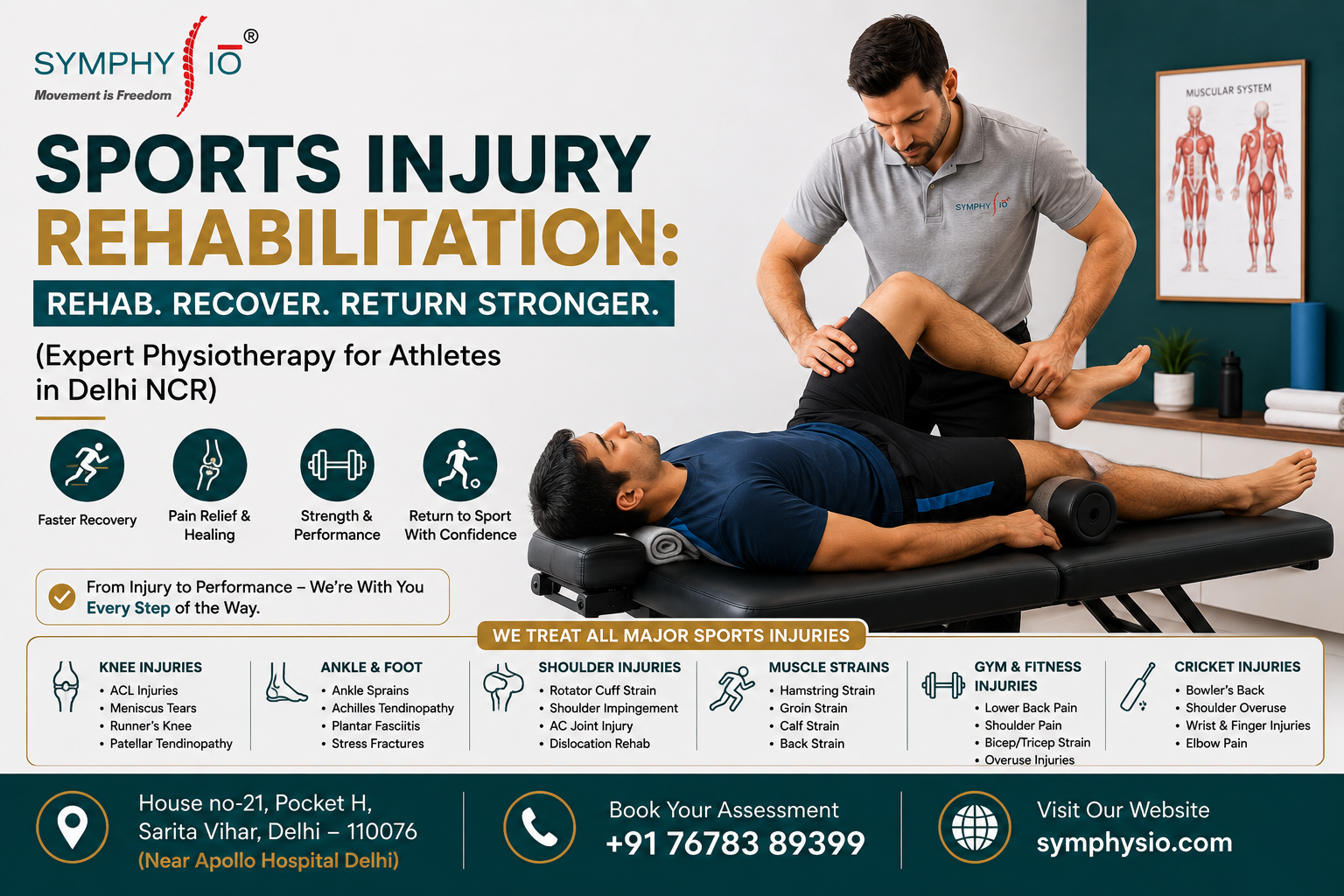
Most Common Sports Injuries Treated at Symphysio
At Symphysio Physiotherapy Clinic, sports rehabilitation can be adapted to the injured body part, the mechanism of injury and the demands of the activity you want to return to.
Knee Injuries
- ACL sprain or tear: Can affect stability during pivoting, landing and changing direction. Rehabilitation focuses on strength, control and appropriate return-to-sport testing.
- Meniscus injury: May cause pain, swelling, clicking or difficulty with deep bending, depending on the injury.
- Runner's knee: Patellofemoral pain commonly affects runners and active people and may be influenced by training load, strength and movement patterns.
- IT band syndrome: Often causes pain on the outer side of the knee, particularly during repetitive running.
- Patellar tendinopathy: Also called jumper's knee, this usually involves load-related tendon pain around the front of the knee.
Ankle and Foot Injuries
- Ankle sprain: One of the most common sports injuries. Proper rehabilitation matters because returning too early can leave ongoing instability.
- Achilles tendinopathy: Often causes load-related pain and stiffness around the Achilles tendon.
- Plantar fasciitis: Common among runners and people who spend long periods on their feet.
- Stress fractures: Repetitive loading can sometimes lead to bone stress injuries and requires appropriate medical assessment and load management.
Shoulder Injuries
- Rotator cuff strain or tear: May cause pain or weakness during lifting and overhead activity.
- Shoulder impingement-type pain: Can occur with repeated overhead movements, although the exact cause requires assessment.
- AC joint injury: Often follows a direct impact or fall onto the shoulder.
- Shoulder dislocation rehabilitation: Requires structured restoration of movement, strength and stability after appropriate medical care.
Back and Hip Injuries
- Lower back strain
- Hip flexor strain
- Hamstring injury
- Groin strain
These injuries can affect sprinting, kicking, lifting and change-of-direction movements.
Cricket-Specific Injuries
Cricket can place different demands on bowlers, batters and fielders.
Common concerns include:
- Bowler's back and lumbar stress problems
- Shoulder overuse
- Hamstring and groin injuries
- Finger and wrist injuries
Gym and Weightlifting Injuries
Common examples include:
- Shoulder pain during bench press
- Lower back strain during deadlifts
- Knee pain during squats
- Biceps and triceps strains
Technique, training load, previous injuries and recovery all need to be considered rather than simply blaming one exercise.
Running Injuries
Common running-related problems include:
- Shin splints
- Runner's knee
- IT band syndrome
- Achilles tendinopathy
- Stress fractures
For running injury physiotherapy Delhi NCR, the goal should include a gradual return to running, not simply short-term symptom reduction.
Why Sports Injuries Happen — Common Causes in Delhi NCR Athletes
Sports injuries are not always caused by one dramatic event. Many develop when training demands increase faster than the body can adapt.
Sudden increase in training load
Doing too much, too soon is a common problem.
Examples include going from occasional gym sessions to six sessions a week, suddenly increasing running mileage or playing multiple matches after a long break.
Poor warm-up and cool-down habits
A warm-up should prepare the body for the activity ahead. Skipping preparation and moving immediately into maximum effort can increase risk in some situations.
A cool-down is not a guarantee against injury, but gradual recovery habits can be part of a well-structured training routine.
Muscle weakness and imbalances
Weakness in key muscle groups may reduce control during demanding movements.
The answer is not always to strengthen one "weak" muscle in isolation. Rehabilitation should consider the whole movement and the demands of the sport.
Incorrect technique
Technique may contribute to overload in:
- Gym lifting
- Running
- Cricket bowling
- Jumping and landing
- Sprinting
Inadequate recovery
Hard training requires recovery.
Poor sleep, insufficient rest between demanding sessions and repeated high-intensity activity without a plan can reduce the body's ability to adapt.
Hard playing surfaces
Concrete courts, hard roads and other unforgiving surfaces can increase repetitive loading.
Surface is only one factor, but it can matter when combined with rapid training progression or poor recovery.
Previous injury not fully rehabilitated
Feeling better is not always the same as being ready for sport.
Returning before strength, power and movement control have recovered can increase the chance of another episode.
Overtraining without structured programming
More training is not automatically better.
A useful programme balances training stress, recovery and gradual progression.
Poor footwear and equipment
Worn-out, unsuitable or sport-inappropriate footwear may contribute to symptoms. Equipment should be considered as one part of the bigger picture.
The PRICE Principle — What to Do Immediately After a Sports Injury
In the first stage after an acute injury, the traditional PRICE approach can provide a simple framework:
- Protection: Avoid activities that could significantly worsen the injury.
- Rest: Prefer relative rest rather than automatically keeping the whole body inactive.
- Ice: A cold pack may help some people with short-term pain relief. Avoid placing ice directly on bare skin.
- Compression: Appropriate compression may help manage swelling in some injuries.
- Elevation: Raising the injured limb can be useful for some people when swelling is present.
Relative rest, not complete rest
If your ankle is injured, you may still be able to maintain fitness through safe training of unaffected areas, depending on the injury.
The goal is to protect the problem without unnecessary deconditioning.
What should you avoid in the first 48–72 hours?
Avoid repeatedly "testing" a painful injury through maximum effort.
Do not force a joint into painful movement, return to contact sport immediately or continue playing simply because adrenaline has temporarily reduced the pain.
Avoid aggressive massage or treatment over a suspected fracture or severe acute injury before appropriate assessment.
When should you go to emergency care?
Seek urgent medical attention after a significant injury if there is:
- Obvious deformity
- Suspected fracture
- Inability to bear weight after significant trauma
- A joint that appears dislocated
- Severe or rapidly increasing swelling with serious trauma
- Numbness, loss of sensation or circulation concerns
- Severe pain after a high-impact injury
For less severe but persistent sports injuries, a physiotherapy assessment may be an appropriate next step.
How Sports Injury Physiotherapy Works — A Phase-by-Phase Breakdown
Recovery does not follow exactly the same calendar for every injury. A minor muscle strain and a post-surgical ACL rehabilitation programme have very different timelines.
The phases below describe a general progression.
Phase 1 — Acute Injury Management (Week 1–2)
The early focus is on understanding the injury and protecting it appropriately.
This phase may include:
- Pain and swelling management
- Protecting the injured tissue
- Maintaining fitness where safely possible
- Early gentle movement to reduce unnecessary stiffness
- Education about the injury and likely rehabilitation process
The goal is to avoid two extremes: ignoring the injury and becoming completely inactive without reason.
Phase 2 — Restoring Movement and Basic Function (Week 2–4)
As symptoms allow, rehabilitation may progress towards:
- Restoring useful range of motion
- Early strengthening
- Balance and proprioception training
- Manual therapy where appropriate
- Sport-modified activity
Proprioception means your body's ability to sense position and movement. It is particularly important after injuries such as ankle sprains and knee ligament injuries.
Phase 3 — Strength and Conditioning (Month 2)
When the injured area is ready for greater loading, the focus becomes more demanding.
Rehabilitation may include:
- Progressive strength training
- Power development
- Endurance building
- Neuromuscular control
- Sport-specific movement patterns
- Gradual return to selected training activities
This is often where a general recovery programme becomes true sports rehabilitation.
A cricketer may progress towards bowling drills. A runner may progress from walking to controlled running. A football player may rebuild acceleration, deceleration and cutting ability.
Phase 4 — Return to Sport (Month 2–3 and Beyond)
Return to sport should be based on more than a calendar date.
This phase may include:
- Sport-specific drills
- Training load progression
- Strength and power assessment
- Movement-quality assessment
- Full practice progression
- Injury-prevention strategies
- Long-term self-management
Some injuries need longer than three months, while minor injuries may progress faster. The injury, severity and response to rehabilitation determine the timeline.
What to Expect at Your First Sports Injury Session at Symphysio
A useful sports injury assessment starts by understanding how the injury happened.
At Symphysio Physiotherapy Clinic, the assessment may include:
- Mechanism of injury
- Previous injuries
- Current symptoms
- Training history
- Recent changes in training load
- Sport and playing position
- Gym or exercise routine
- Movement goals
Movement and biomechanical assessment
Depending on the injury, the physiotherapist may assess:
- Joint movement
- Strength
- Balance
- Walking or running pattern
- Squatting and landing
- Single-leg control
- Sport-specific movement
- Relevant mobility restrictions
Looking for contributing factors
The injury may be influenced by factors such as:
- Weakness
- Poor movement control
- Technique
- Excessive training load
- Inadequate recovery
- Previous injury
A personalised return-to-sport plan
Dr. Rahul Bhandari, Physiotherapist and Certified Chiropractor with USA and UK credentials, builds rehabilitation around the individual's injury and activity goals.
A runner, cricketer and gym athlete should not automatically receive the same programme simply because they have pain in the same body part.
Realistic timelines are discussed according to injury type, severity and progress.
Treatments Used at Symphysio for Sports Injuries
Treatment is selected according to clinical findings and individual suitability.
Manual therapy and joint mobilisation
Hands-on treatment may be used to help address movement restrictions and symptoms when appropriate.
It is generally combined with active rehabilitation rather than used as a substitute for rebuilding strength and capacity.
Dry needling
Dry needling may be considered for selected muscle trigger points or muscle-related pain.
For tendon problems, rehabilitation usually also requires appropriate progressive loading rather than relying on one passive technique.
Fascial manipulation
Fascial techniques may be used as part of a broader treatment approach where clinically appropriate.
Chiropractic adjustment where appropriate
Manual or chiropractic techniques may be considered after assessment when relevant to the patient's presentation.
They are not required or suitable for every sports injury.
Sports-specific exercise rehabilitation
Exercises should progressively resemble the demands of the sport.
A programme may move from basic strength to jumping, sprinting, cutting, throwing, bowling or other activity-specific tasks.
Strength and conditioning programming
The aim is to rebuild capacity, not just eliminate symptoms.
Strength, endurance and power can be progressed according to the athlete's needs.
Biomechanical and running gait analysis
Movement analysis may help identify relevant patterns during running and other activities.
The purpose is not to label one running style as universally "perfect," but to understand how the individual moves and what loads may be contributing to symptoms.
Taping and bracing guidance
Taping or bracing may provide temporary support in selected situations.
It should not replace rehabilitation of strength, control and confidence.
Return-to-sport testing and clearance
Where appropriate, progression can include assessment of:
- Strength
- Power
- Balance
- Movement control
- Sport-specific tolerance
- Confidence
No single test guarantees that reinjury cannot occur, but objective and functional assessment can provide better information than returning simply because pain has disappeared.
Return to Sport — What It Really Means
This is one of the most important parts of sports injury rehab Delhi.
No pain does not automatically mean full recovery.
A football player may be pain-free while jogging but still struggle with sprinting and cutting. A gym athlete may be able to lift light weights but not yet tolerate previous training loads.
Return to sport requires more than symptom relief
A return-to-sport plan should consider:
- Strength restoration
- Power restoration
- Endurance
- Movement quality
- Balance and coordination
- Sport-specific skills
- Ability to tolerate training load
- Confidence and psychological readiness
Why rushing increases reinjury risk
Rushing back before the body is prepared can expose healing or deconditioned tissues to demands they cannot yet tolerate.
The exact reinjury risk varies greatly by sport and injury, so there is no single percentage that applies to everyone. The practical lesson is simple: meeting functional criteria is usually more useful than returning solely because a certain number of days have passed.
How a return-to-sport progression works
A typical progression may move from:
- Daily activities without significant symptom aggravation
- Basic strength and controlled movement
- Higher-load exercise
- Running, jumping or other relevant athletic tasks
- Sport-specific drills
- Modified training
- Full training
- Competitive return when clinically and functionally appropriate
The progression is adjusted if symptoms or performance show that the previous stage was advanced too quickly.
Injury Prevention — How to Avoid Coming Back With the Same Problem
No programme can guarantee that you will never be injured again.
However, good training habits can reduce avoidable risk.
Use a proper warm-up
Prepare for the activity you are about to perform.
A useful warm-up can include gradually increasing intensity and sport-specific movements rather than immediately starting at maximum effort.
Build strength and conditioning
Recreational athletes benefit from basic strength training too.
Appropriate strength can improve the ability to tolerate running, lifting, jumping and contact demands.
Manage training load
Increase volume or intensity gradually.
A sudden jump in weekly kilometres, gym volume or match frequency is often harder to tolerate than a planned progression.
Improve technique where relevant
Technique correction can be useful for lifting, running, bowling, landing and other repeated movements.
Technique is not the only factor, but better movement efficiency may help manage unnecessary stress.
Prioritise recovery
Recovery includes:
- Sleep
- Appropriate rest between demanding sessions
- Nutrition
- Hydration
- Sensible weekly training structure
Consider a physiotherapy assessment before an injury becomes serious
Persistent discomfort, repeated niggles or recurring pain are worth assessing before they become a longer-term problem.
Sports physiotherapy can also help with movement screening, training advice and return-to-activity planning.
Sports Injury Physiotherapy for Specific Groups in Delhi NCR
Cricket Players
Cricket remains central to the Delhi NCR sports environment.
Rehabilitation may address bowling-related back load, shoulder overuse, hamstring and groin injuries, and the progressive return to batting, bowling and fielding.
A return-to-cricket plan should consider the player's role and workload. A fast bowler and a recreational batter do not face identical demands.
Gym and CrossFit Athletes
For gym injury treatment South Delhi, rehabilitation may examine:
- Training volume
- Exercise technique
- Previous injuries
- Strength imbalances
- Recovery habits
- Sudden changes in programme intensity
The goal is often to modify training rather than stopping all exercise unnecessarily.
Runners and Marathon Athletes
Delhi NCR's running community continues to include participants in shorter races, half marathons and full marathons.
Running injury physiotherapy Delhi NCR may include load management, progressive return-to-running plans, strength work and running movement assessment where appropriate.
Football and Futsal Players
Football and futsal involve sprinting, cutting, kicking and rapid changes of direction.
Knee and ankle rehabilitation should therefore progress beyond walking and jogging before a full return to play.
Why Athletes From Sarita Vihar, Okhla, Jasola and South Delhi Choose Symphysio for Sports Injury Rehab
For athletes searching for best sports physiotherapy clinic Delhi, treatment should match the demands of the activity they care about.
Convenient for South Delhi and nearby Noida
Symphysio Physiotherapy Clinic serves patients from:
- Sarita Vihar
- Jasola
- Okhla
- Badarpur
- New Friends Colony
- Kalindi Kunj
- Sukhdev Vihar
- Kalkaji
- CR Park
- Tughlakabad
- Govindpuri
- Madanpur Khadar
- Nearby Noida
The clinic is located at House no-21, Pocket H, Sarita Vihar, Delhi — 110076, near Apollo Hospital Delhi.
Dr. Rahul Bhandari's credentials
Treatment is led by Dr. Rahul Bhandari, Physiotherapist and Certified Chiropractor with USA and UK credentials.
His approach includes individual assessment and rehabilitation based on the injury, training demands and return-to-sport goals.
Sport-specific rehabilitation
A generic exercise programme is not always enough.
The final stages of rehabilitation should prepare you for the actual demands of cricket, running, football, gym training or another activity.
Manual therapy and dry needling expertise
Where clinically appropriate, manual therapy and dry needling may be used alongside progressive exercise-based rehabilitation.
Return-to-sport focus
The goal is not simply to become pain-free.
Rehabilitation aims to restore the strength, movement, capacity and confidence needed for a safer return to activity.
Home visits where needed
Home-visit physiotherapy may be available for suitable patients depending on location and service availability.
Patient experience
Symphysio has a 4.9-star rating and has served 100+ patients.
Conclusion + Call to Action
A sports injury should not automatically mean choosing between pushing through pain and stopping everything for weeks.
The most useful approach is often structured rehabilitation: protect the injury when needed, restore movement, rebuild strength and conditioning, then progressively return to the specific demands of your sport.
Whether you are dealing with an ankle sprain, knee injury, gym-related pain, running problem or cricket injury, the final goal should go beyond short-term pain relief. A good rehabilitation programme prepares you for performance and helps reduce the risk of returning before you are ready.
If you are looking for sports injury treatment Delhi, sports physiotherapy Sarita Vihar, knee injury physiotherapy Okhla, ankle sprain treatment Delhi NCR, cricket injury physiotherapy Delhi or return to sport physiotherapy Delhi, an early individual assessment can help guide the right next steps.
Symphysio Physiotherapy Clinic
House no-21, Pocket H, Sarita Vihar, Delhi — 110076
Near Apollo Hospital Delhi
Phone: +91 76783 89399
Clinic consultations are available, along with home-visit and online options depending on patient needs and service availability.
Discuss your symptoms with a physiotherapist
If symptoms affect everyday activity, explore assessment and physiotherapy options or book an appointment. This information cannot diagnose your symptoms; read our medical disclaimer.
Frequently Asked Questions
It depends on the injury. A mild muscle strain may improve relatively quickly, while ligament injuries, tendon problems, stress injuries and post-surgical rehabilitation can take much longer. Your timeline should be based on injury severity and functional progress.
Complete rest is not always necessary. Many injuries benefit from relative rest followed by appropriately graded movement and exercise. However, suspected fractures, dislocations and severe injuries require appropriate medical assessment.
In some cases, structured rehabilitation can help patients regain function without surgery. However, whether surgery is appropriate depends on the specific ligament, severity of injury, instability, sport demands and other clinical factors. An individual assessment is essential.
Return should not be based only on the absence of pain or a fixed number of days. Strength, movement, power, sport-specific tolerance and confidence should all be considered before progressing to full training or competition.
Dry needling may help selected muscle-related problems and trigger points. It is not a replacement for rehabilitation. Strength, progressive loading and sport-specific exercise are often essential for long-term recovery.
Yes. Symphysio Physiotherapy Clinic can assess common gym-related problems such as shoulder pain, lower back strain, knee pain and muscle injuries. The rehabilitation plan can be adjusted around your training goals and the exercises you want to return to.
Sometimes modified training is possible and even useful. The decision depends on the injury and the activity. A physiotherapist can help identify which exercises can be continued and which should be temporarily modified.
Yes. Sports rehabilitation can progress from symptom management to strength, conditioning, functional testing and sport-specific activity. The exact return-to-sport plan depends on the injury and the demands of your sport.
References
These sources provide background guidance and research. Evidence and suitability vary by condition and technique; discuss benefits, risks and alternatives with your clinician.
General health information cannot diagnose your symptoms or replace individual medical advice. Do not delay urgent care for concerning symptoms. Read our medical disclaimer.
Book an assessment at Symphysio
Talk to our team in Sarita Vihar and get a plan built around your symptoms, not a fixed protocol.